.svg)

You’ve got your SOC 2 report. Maybe your ISO 27001 too. And yet every enterprise deal still hits the same wall: “Can you send over your security documentation?” Then a week later: “We have a questionnaire.” Then another one. Then a follow-up on the first one.
Trust center software is supposed to solve this. A single portal where buyers can access your certifications, policies, and security posture without pulling your security team into another email thread. The pitch is compelling. The category, though, is fragmented: some tools are standalone portals, some are features inside compliance platforms, and some are really just questionnaire automation with a landing page.
I reviewed 10 trust center software tools, looking at how well each one handles the actual portal experience, what they do for questionnaire volume, and whether the pricing makes sense for a startup or a scaling team. Here’s what I found.
Why repetitive questionnaires and security review delays are killing your deal velocity
Security reviews have become a standard gate in enterprise procurement. The deal is moving, the champion is bought in, then procurement sends a 200-question spreadsheet. Or a portal link. Or both.
Key insight
A trust center addresses the structural issue: instead of your security team answering the same questions repeatedly, buyers self-serve from a public or gated portal that shows your live compliance status, certifications, and key policies.
The manual response loop is expensive. Companies that handle questionnaires without automation can spend several hours on each one, and high-volume teams field 50+ per month. That is not a compliance problem. It is a sales velocity problem.
A trust center addresses the structural issue: instead of your security team answering the same questions repeatedly, buyers self-serve from a public or gated portal that shows your live compliance status, certifications, and key policies. The best tools also automate the questionnaire response itself, using your own documentation as the knowledge base so AI can handle the first pass.
Two types of tools compete in this space. Standalone trust centers like SafeBase and TrustCloud are purpose-built for the buyer portal experience. Compliance platforms like Vanta, ComplyJet, and Sprinto include a trust center as part of a broader compliance automation suite. Which type you need depends almost entirely on whether you are also buying compliance tooling for the first time, or already have that covered.
How we evaluated these 10 trust center tools
The 10 tools below were selected based on editorial SERP frequency, review platform presence, and market coverage across the trust center and compliance automation categories. Here is what I weighted:
Why it matters
The 10 tools below were selected based on editorial SERP frequency, review platform presence, and market coverage across the trust center and compliance automation categories.
- Trust center completeness: Can buyers actually self-serve? Are there NDA gates, access controls, a branded portal, and analytics on who viewed what?
- Questionnaire automation: Does the tool reduce the manual work of answering security questionnaires, or does it just store your documents?
- Compliance depth: How many frameworks are supported? Is monitoring continuous, or does the tool require manual updates?
- Startup-friendliness: Transparent pricing, fast setup, and a support model that works for teams without a dedicated compliance team.
- Real user evidence: Ratings and review quality across third-party platforms, not just volume.
- Integration ecosystem: Connections to CRM, Slack, and identity providers matter for workflow automation.
Quick comparison: the 10 best trust center software tools in 2026
| Tool | Best for | Pricing | Standout feature |
|---|---|---|---|
| Vanta | Mid-market compliance + trust | Custom quote | AI chatbot for buyer Q&A |
| SafeBase (by Drata) | Enterprise-grade trust center | Custom quote | $15B in security-enabled revenue |
| ComplyJet | Startups, flat-rate compliance | From $5,000/year | Flat pricing, guided outcomes |
| Conveyor | High questionnaire volume | From $9,600/year | 95%+ AI accuracy |
| TrustCloud | Early-stage or CISO-led teams | Free to $400/mo | Free tier for under 20 employees |
| OneTrust | Enterprise multi-regulatory | From $10,000/year | Broadest privacy and GRC coverage |
| Sprinto | Startups, affordable compliance | From ~$6,000/year | Trust center live in 2 minutes |
| Secureframe | SMBs wanting proven tooling | Custom quote | 6,000+ customers, 4.7/5 |
| 1up | Sales teams, lightweight portal | Custom quote | 4.9/5, AI answer hub |
| SecurityPal | Complex questionnaires, human backup | Custom quote | 12-hr turnaround with 150+ analysts |
Free Demo
Get compliant and share your trust center in one product
SOC 2 and ISO 27001. Flat pricing, 350+ integrations, trust center included.
The 10 best trust center software tools in 2026
1. Vanta

Vanta built its reputation as the default compliance platform for mid-market SaaS, and the trust center is where that reputation translates most directly into revenue. The product has evolved well past “here is your SOC 2 badge”: AI chatbot that answers buyer questions in real time, automated NDA collection through DocuSign and Ironclad, CRM integration to tie security reviews to pipeline data, and analytics that show which prospects have accessed your portal and what they looked at.
The AI chatbot is genuinely useful. It uses your company’s own documentation as the knowledge base, so when a prospect asks “do you support SSO?” after hours, they get a sourced answer without waking up your security team. Vanta calls this the Advanced Trust Center, available on Professional and above.
The tradeoff is cost complexity. The base platform is custom-quoted, a basic Trust Center is included at all tiers, but the Advanced Trust Center features require an upgrade. If you are already using Vanta for SOC 2 or ISO 27001, extending into the trust center is a natural next step. If you are evaluating Vanta primarily for the trust portal, check our Vanta pricing guide before committing to what the cost actually looks like at your stage.
“
The Trust Center reduces the administrative burden of security reviews significantly. The ability to just drop a link instead of filling out a spreadsheet is a game-changer for deal velocity.
★★★★★Verified User· SMB
Via G2 ↗Key features:
- AI chatbot for real-time buyer Q&A, sourced from your own documentation
- Automated access approvals and NDA collection via Salesforce, HubSpot, DocuSign, Ironclad
- ROI reporting tied to pipeline deals
- 400+ integrations
- Custom tags and filters for tailored document sharing
- Advanced Trust Center on Professional tier and above
Pros of Vanta
- 4.6/5 across 2,352 reviews: the most validated platform on this list
- Deepest integration ecosystem (400+)
- AI-powered buyer experience is a genuine differentiator
- Trust center included at all plan tiers
Cons of Vanta
- Per-seat pricing gets expensive as the team scales
- Advanced Trust Center features require a higher-tier plan
- Custom-only pricing makes comparison difficult without a sales call
Pricing: Custom quote; Trust Center included in all plans; Advanced Trust Center on Professional and above
Best for: Mid-market SaaS companies that want compliance automation and trust center in one enterprise-grade platform
2. SafeBase (by Drata)
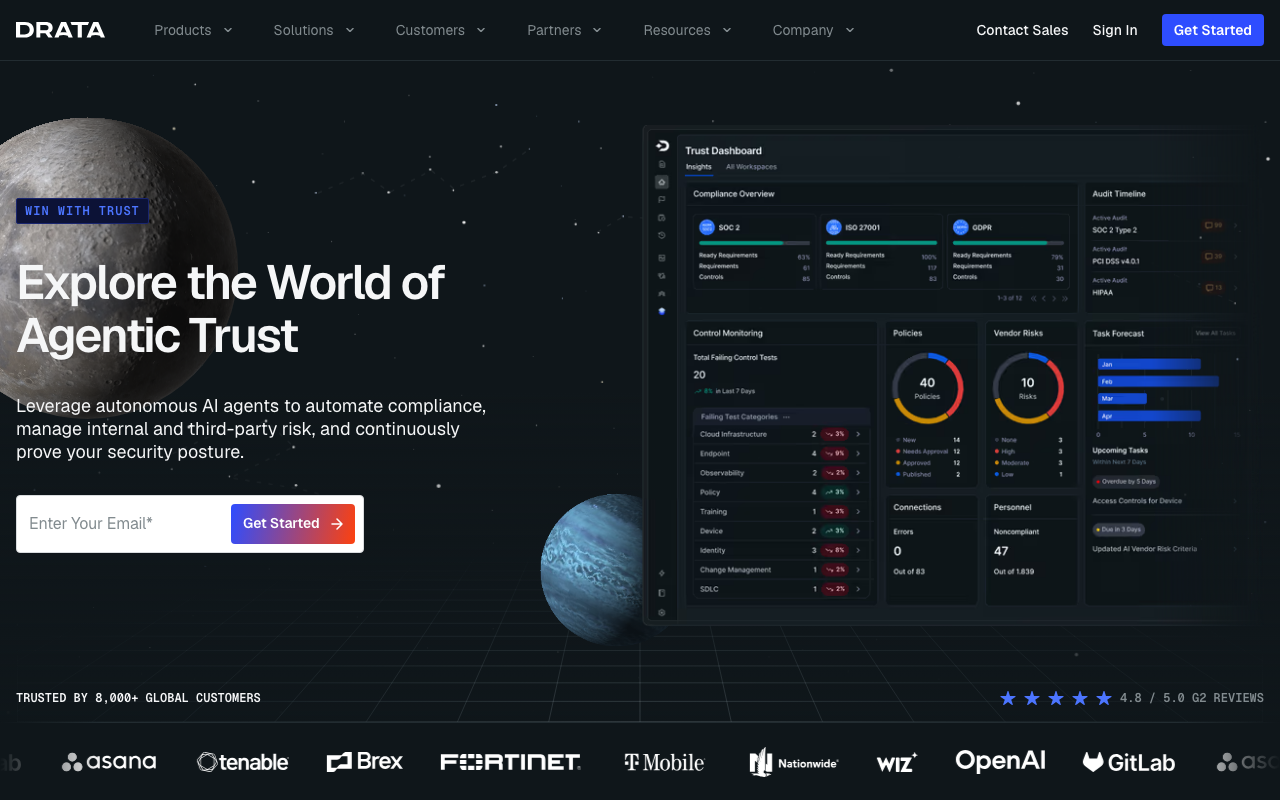
The trust center category exists largely because SafeBase built it. Before SafeBase, most companies shared security documentation via emailed PDFs or locked Google Drive folders. SafeBase created a dedicated buyer portal, and the adoption numbers reflect it: one-third of the Cloud 100 use SafeBase trust centers, and the company has reported approximately $15B in security-enabled revenue across its network. In February 2025, Drata acquired SafeBase for $250M, and it now operates as “Drata Trust Center powered by SafeBase.”
What sets SafeBase apart from compliance platforms that bundle trust centers is the depth of the buyer experience. The Trust Library is searchable. Document sharing has granular audit trails: you can see exactly who viewed what and when. Multi-product profiles let you show different trust postures for different product lines. AI questionnaire assistance handles third-party portals, not just your own. If you are already on Drata for compliance, the trust center is an obvious extension.
The gap: pricing is opaque post-acquisition and the platform makes most sense if you are already in the Drata ecosystem. If you are on Vanta or Sprinto and considering SafeBase as a standalone add-on, the cost conversation is harder to have.
Our Drata review covers the broader compliance platform in detail if you are evaluating both sides of the tooling at once.
“
The ease of securely sharing documentation with audit trails and granular access controls is exceptional — it eliminated back-and-forth emails and gave us clear visibility into who viewed and downloaded what. I would recommend this solution without hesitation.
★★★★★Verified User· SMB
Via G2 ↗Key features:
- Trust Library: searchable, centralised security content hub
- Granular document access controls with full audit trail
- AI questionnaire assistance for third-party portals
- Multi-product trust center profiles
- NDA collection and document-view analytics
- Trust Measurement dashboard
- 8,000+ global customers via Drata
Pros of SafeBase
- Deepest trust center feature set on this list
- Enterprise network effect: OpenAI, Asana, T-Mobile, Zoom, CrowdStrike, HubSpot all use SafeBase
- Purpose-built portal experience, not a compliance-platform add-on
- Strong support scores across review platforms
Cons of SafeBase
- Pricing opaque since Drata acquisition: requires a sales conversation
- Trust center only: compliance automation requires Drata separately
- Overkill for early-stage teams who need a basic portal
Pricing: Contact for pricing
Best for: Companies wanting the market-leading standalone trust center, especially those already using Drata for compliance
3. ComplyJet
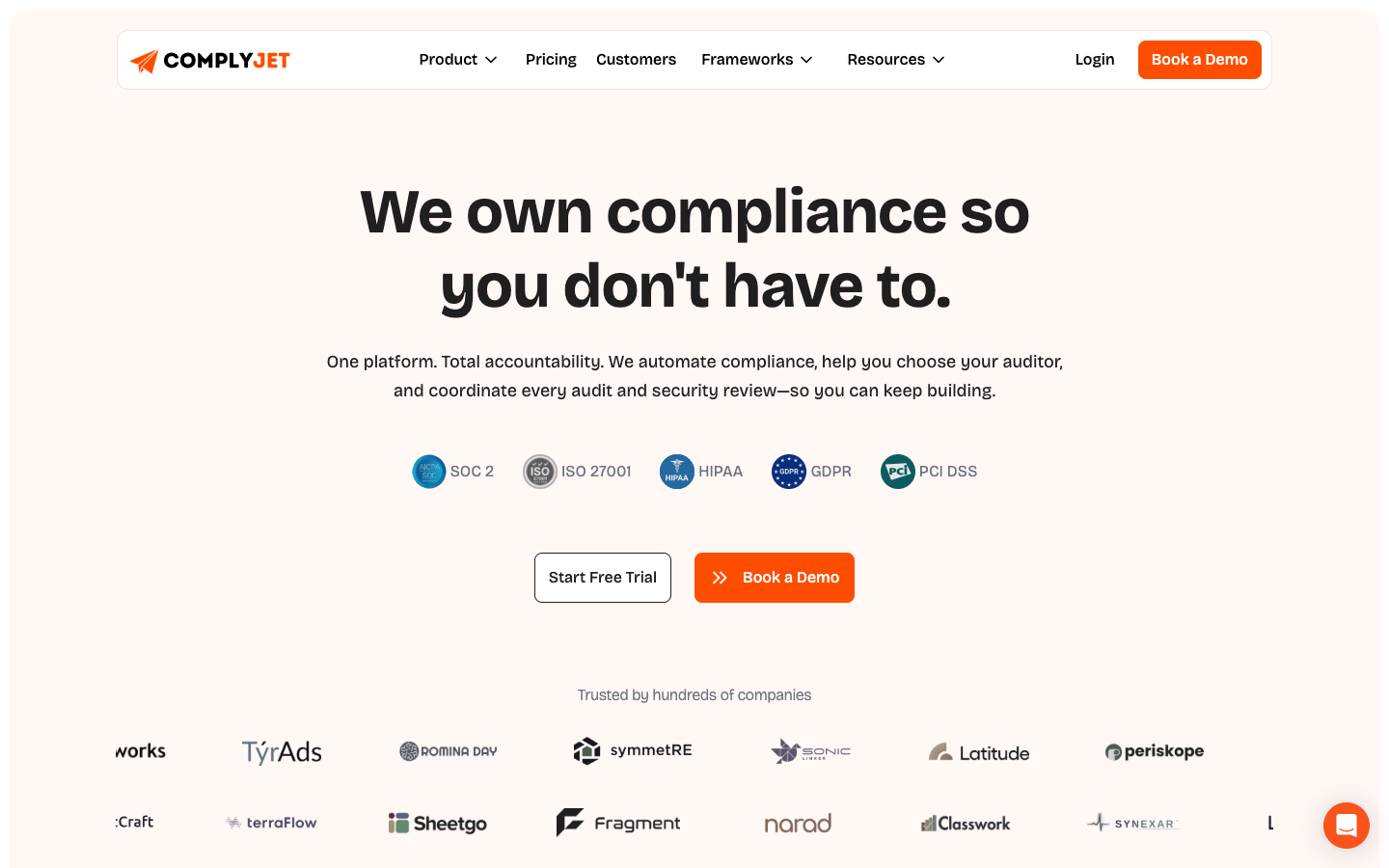
Most compliance platforms start with monitoring and attach a trust center as an afterthought. ComplyJet is built around outcomes: you get compliant, you get certified, and your trust center reflects that status in real time. The platform covers SOC 2, ISO 27001, HIPAA, GDPR, PCI DSS, and 25+ other frameworks, with a team that guides you through the process rather than leaving you to navigate it alone.
The differentiator worth paying attention to is flat pricing. ComplyJet charges $5,000/year for a single framework and $8,000/year for two. That is per company, not per seat. Whether your team is 10 people or 50, the cost does not change. For growing teams, that kind of predictability matters when you are budgeting 12 months out.
The trust center is included. It updates as your compliance posture changes, lets you share certifications with prospects, and handles document access requests without adding a task to your security team’s queue. This is not a bolt-on feature. It is the natural output of getting compliant in the first place.
Where ComplyJet is honest about its limits: it is built for early-stage teams pursuing their first certification. If you have complex multi-entity compliance needs or need deep enterprise GRC, you will likely grow into a more heavyweight platform over time.
“
The platform makes it simple: it splits the work into four buckets with clear, bite-sized tasks we could fit into our routine. No sales gauntlet or upselling. The clearest, most sensible option.
Artur G· CTO · Symmetre
Via complyjet.com ↗
Key features:
- Built-in trust center, live-updated as compliance posture changes
- AI-assisted policy drafting
- Automated evidence collection
- 350+ integrations
- Flat per-company pricing, not per seat
- Team guides you through the process from kickoff to audit close
- SOC 2, ISO 27001, HIPAA, GDPR, PCI DSS, and 25+ frameworks
Pros of ComplyJet
- Flat pricing ($5K or $8K/year) is predictable as the team scales
- 350+ integrations
- Guided outcome delivery: not just software, but a process with a team behind it
- Trust center included with no add-on cost
Cons of ComplyJet
- Newer platform with fewer third-party reviews than Vanta or Secureframe
- Best suited for early-stage teams: not the right fit for enterprise GRC complexity
Pricing: $5,000/year (single framework), $8,000/year (two frameworks). Per company, not per seat.
Best for: Early-stage startups (seed to Series A) pursuing their first compliance certification, with trust center included
4. Conveyor
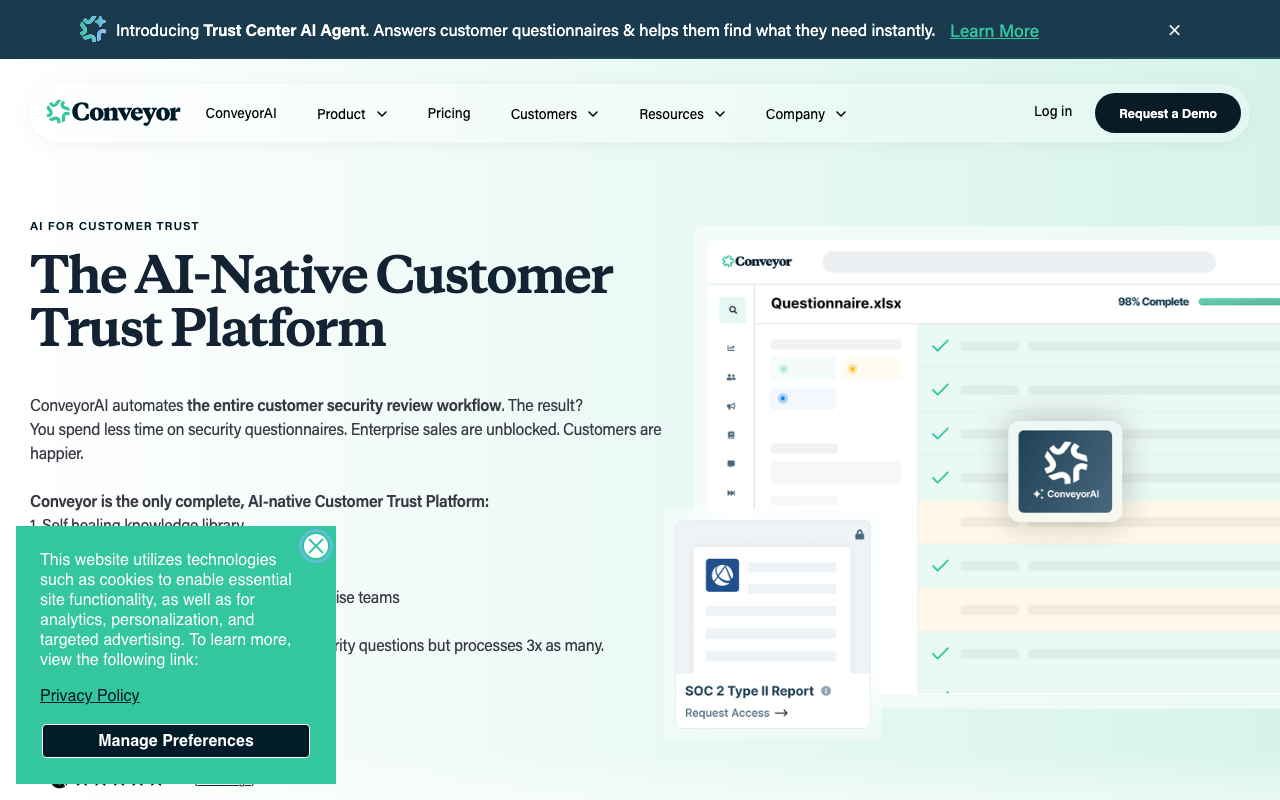
If your deal desk is fielding more than 10 security questionnaires per month, Conveyor is the most purpose-built tool on this list for that specific problem. The platform automates the entire security review workflow: trust center with NDA gates, AI agents that fill questionnaires in any format, a browser extension for portal-based questionnaires, and RFP automation with red-flag detection. Customers report 75-91% time savings on questionnaire response.
The AI accuracy numbers are notable: 95%+ accuracy and a claimed sub-0.01% hallucination rate. The knowledge library self-heals by pulling from your website, Google Drive, and other connected sources, so it stays current as your documentation changes. The multilingual support covers 50+ languages, which matters for companies selling into European enterprise where questionnaires arrive in German or French.
The main friction point is cost structure. Conveyor uses a credit-based model starting at $9,600/year, and G2 reviewers flag that high questionnaire volume or large trust center access counts can burn through credits faster than expected. This is not a tool to buy if questionnaire volume is low. At scale, the ROI is clear. Below roughly 10 questionnaires per month, you are likely paying for more than you need.
“
Conveyor makes the security review process incredibly smooth and transparent. It centralizes all compliance documentation in one place, reducing back-and-forth with customers and saving valuable time for both sales and security teams.
★★★★★Account Executive· SMB
Via G2 ↗Key features:
- Trust Center with 1-click NDA gates and AI-powered buyer self-service
- Security questionnaire automation in any format
- RFP automation with automated red-flag detection
- Browser extension for portal-based questionnaire auto-fill
- Self-healing knowledge library (multi-source)
- 50+ language support with source citations
- Salesforce, Slack, HubSpot integrations
Pros of Conveyor
- Best-in-class questionnaire automation accuracy (95%+)
- Handles all questionnaire formats including portal-based
- Strong customer roster: Zapier, Figma, Atlassian, dbt Labs, Carta
- Multilingual support for international questionnaire volume
Cons of Conveyor
- Credit-based model becomes expensive at high questionnaire volume
- Minimum $9,600/year is steep for early-stage teams
- Trust center is secondary to the questionnaire tool
Pricing: From $9,600/year; credit-based model
Best for: Sales-led companies with high security questionnaire volume (10+/month) looking to automate end-to-end
5. TrustCloud
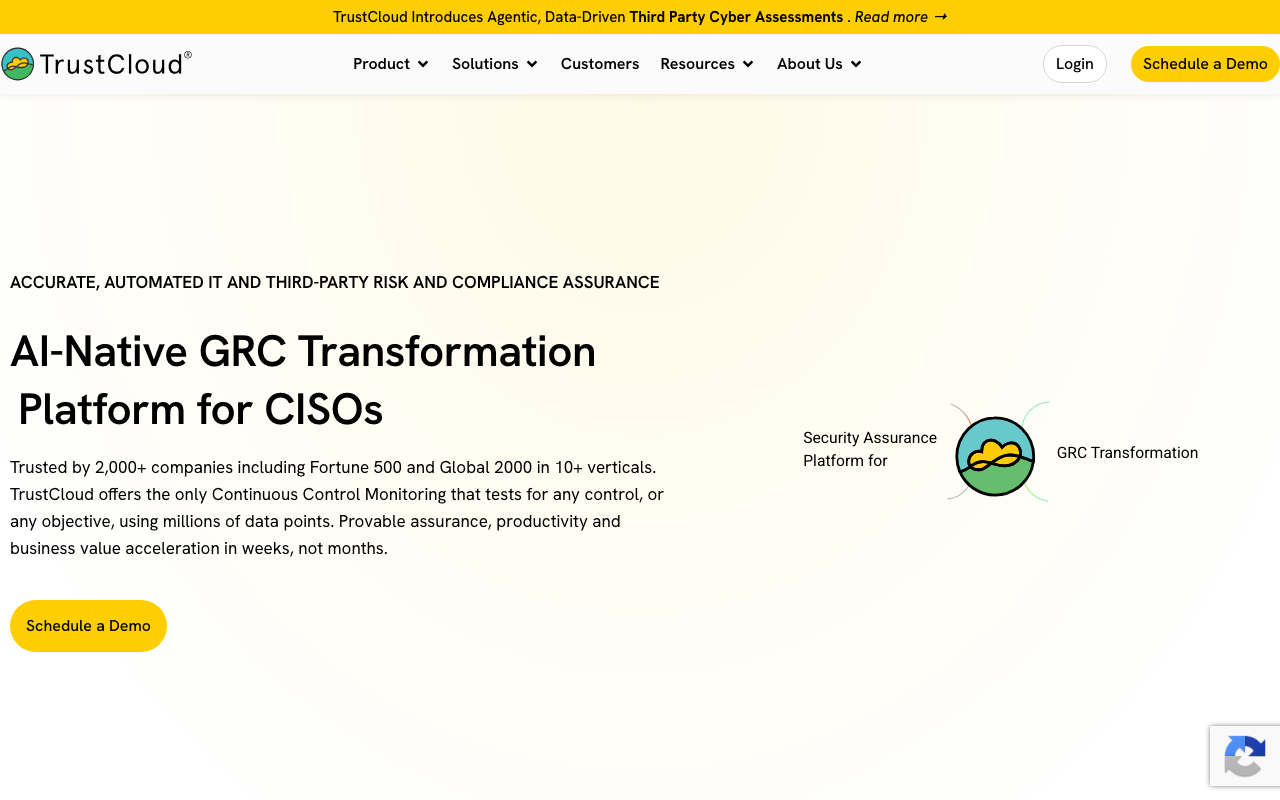
TrustCloud is one of the few tools in this category with a free tier that is actually useful: companies under 20 employees can use TrustOps (compliance automation) and TrustShare (the trust center) at no cost. For very early-stage teams who need to show a security posture to enterprise prospects but are not ready to spend $6K on a platform, that is a genuine option.
The platform goes deeper than most for teams that grow past the free tier. Continuous control monitoring across millions of data points, risk quantification, third-party risk assessment automation, and ISO 42001 support for AI governance. The TrustRespond product adds questionnaire automation with up to 85% pre-fill.
The cost structure is where it gets complicated. TrustRespond starts at $10,000/year and requires TrustOps as a prerequisite. So the full trust center plus questionnaire automation stack is a significant investment. G2 users flag expensive upgrades and integration setup friction as recurring pain points. If you are on the free tier and the platform serves your current needs, plan the upgrade path before you hit it.
“
TrustCloud's automation features greatly reduce manual effort for compliance tasks. The risk scoring, control mappings, and evidence collection give us clear visibility across all our frameworks in one place.
★★★★★Verified User· SMB
Via G2 ↗Key features:
- TrustShare (customer-facing trust center)
- TrustRespond (questionnaire automation, up to 85% pre-fill)
- Continuous control monitoring
- Risk quantification and predictive analytics
- Third-party risk assessment automation
- ISO 42001 and NIST AI RMF support
- Free forever plan for companies under 20 employees
Pros of TrustCloud
- Only tool on this list with a meaningful free tier
- Strong framework coverage: SOC 2, ISO 27001, ISO 42001, NIST AI RMF, CMMC, and more
- CISO-level depth: risk quantification, third-party risk, continuous monitoring
- Active platform with reviews through early 2026
Cons of TrustCloud
- Questionnaire automation is a significant add-on ($10K+/year on top of TrustOps)
- Smaller review footprint than Vanta or Secureframe
- Users flag expensive upgrade paths and cumbersome integrations
- Free tier limited to companies under 20 employees
Pricing: Free forever (under 20 employees); TrustOps Starter from $400/month; TrustRespond from $10,000/year (requires TrustOps)
Best for: Very early-stage startups on the free tier, and CISO-led teams wanting unified GRC plus trust center without stitching tools together
6. OneTrust
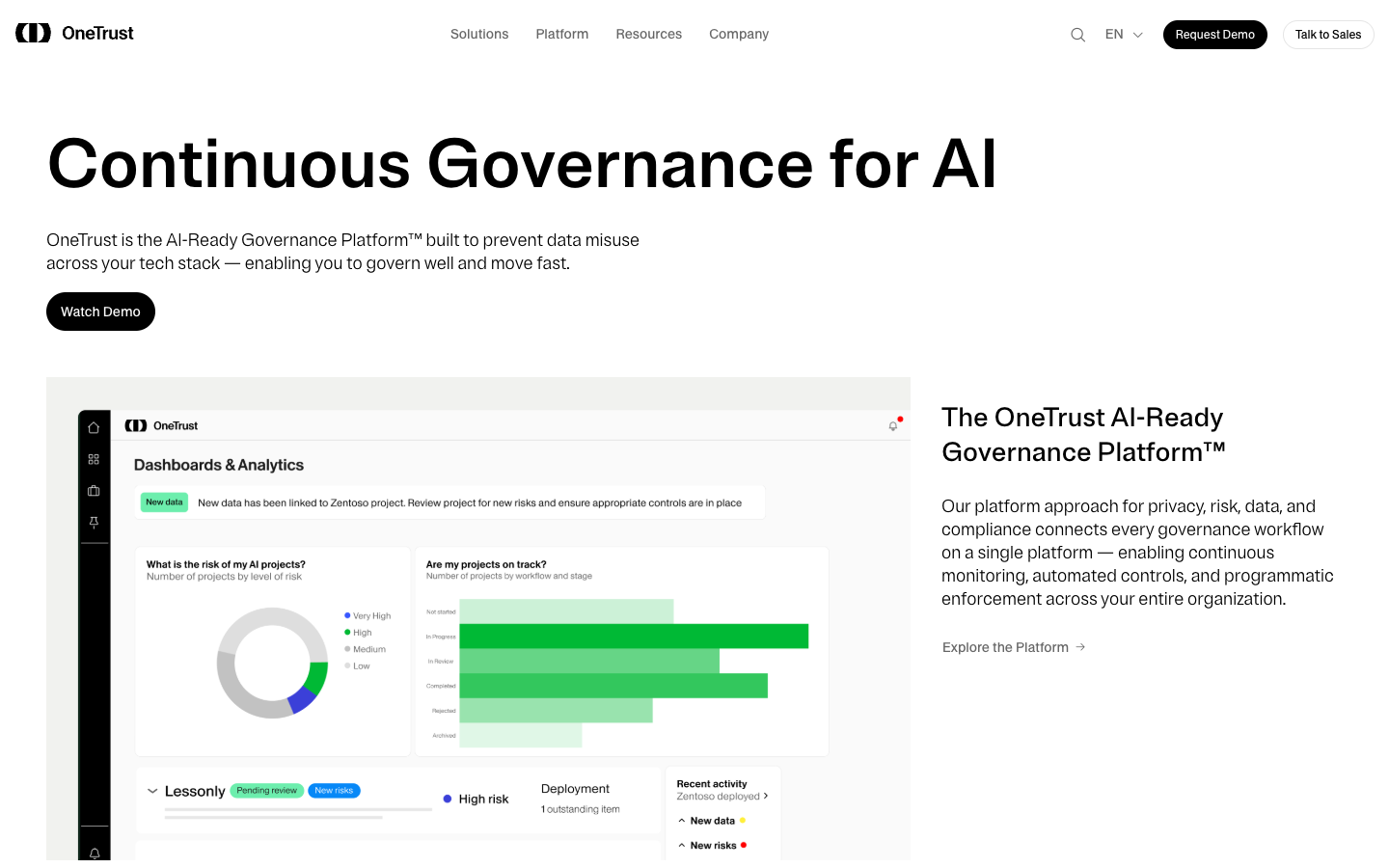
OneTrust is the dominant enterprise platform for privacy, GRC, and compliance. The trust center is one module inside a platform that covers consent management, data governance, DSR automation, vendor risk, and regulatory change intelligence. If your compliance needs span GDPR, CCPA, and a complex cross-border data map, OneTrust has the depth to cover it.
The honest framing: this is not a startup tool. The minimum contract is $10,000/year from Q2 2026, climbing to $40K+ for mid-market and $120K-$500K+ for enterprise. Implementation takes weeks or months. G2 reviewers consistently praise the platform’s power but note that smaller accounts feel underserved after the contract is signed. Support is strong for enterprise customers with dedicated success managers. For everyone else, it can feel like you are managing OneTrust as a second job.
If you are a large enterprise managing global privacy obligations, trust center, and GRC under one roof, OneTrust makes a strong case. If you are a 30-person startup trying to get your SOC 2 done and share a trust portal with prospects, this is the wrong tool.
“
OneTrust Tech Risk & Compliance is powerful for automation capabilities and centralized risk management. The main downsides are a steep learning curve and inconsistent support for smaller accounts — once the contract is signed, small teams often feel like an afterthought.
★★★★☆Verified User· Enterprise
Via G2 ↗Key features:
- Trust Center module
- Privacy automation (consent, DSR, data transfers)
- Tech Risk and Compliance
- Data and AI governance
- Vendor risk assessment
- Regulatory change intelligence
Pros of OneTrust
- Broadest coverage of global privacy regulations (GDPR, CCPA, and beyond)
- Dedicated modules for every compliance domain
- Strong for enterprises managing complex cross-border data obligations
Cons of OneTrust
- Minimum $10,000/year; enterprise pricing reaches $500K+
- Steep learning curve and long implementation timelines
- Support quality inconsistent for smaller accounts
- Trust center is one module among many: not a first-class standalone feature
Pricing: Custom quote; minimum $10,000/year from Q2 2026; SMB $10K-$40K/year; Enterprise $120K-$500K+/year
Best for: Large enterprises with complex multi-regulatory privacy and GRC requirements
7. Sprinto
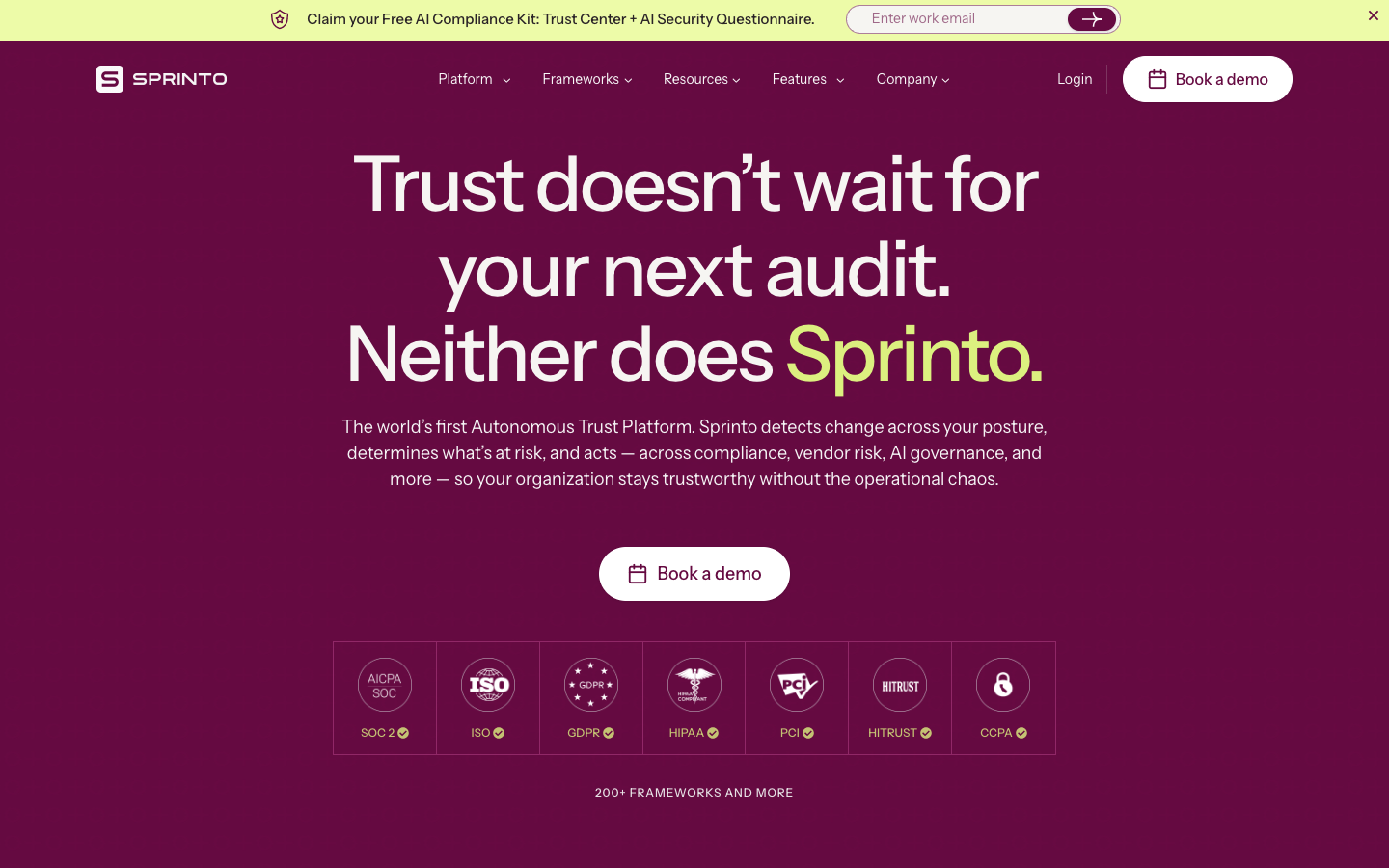
Sprinto is the fastest entry point for startup teams that need both compliance automation and a trust center without a large budget. The trust center goes live in under two minutes, supports gated or open configurations, and includes NDA gates, expiry links, domain-level permissions, and activity tracking. It is included in every plan, with no additional cost.
The compliance automation underneath is strong: 300+ integrations, 200+ supported frameworks, and automated evidence collection from AWS, Google Workspace, and Okta. The platform has 4.8/5 across 1,563 reviews, putting it among the most validated options in the compliance space. Given that Sprinto is often the first tool a startup uses for SOC 2 or ISO 27001, the trust center being available on day one of onboarding is useful rather than an afterthought.
Where Sprinto’s trust center falls short of SafeBase: the buyer portal experience is more functional than polished, and questionnaire automation is basic compared to Conveyor or SecurityPal. But if your primary need is compliance automation with a trust center bundled in, Sprinto at $6-8K/year is hard to argue with.
Read our Sprinto review for a deeper look at the compliance side of the platform, including where it underperforms.
“
The Trust Center makes it easy to securely share compliance artifacts with customers in a controlled manner. Combined with automated evidence collection, Sprinto has saved us weeks of effort during our SOC 2 audit.
★★★★★Verified User· SMB · 11–50 employees
Via G2 ↗Key features:
- Trust Center live in under 2 minutes; gated or open
- NDA gates, expiry links, activity tracking, domain-level access permissions
- 300+ integrations
- 200+ compliance frameworks
- Automated evidence collection from AWS, Okta, Google Workspace
- Built-in security awareness training
- Vendor risk management
Pros of Sprinto
- Trust center included in base plan at no extra cost
- 4.8/5 across 1,563 reviews: highest volume-weighted score on this list
- Competitive starting price (~$6-8K/year)
- Fastest trust center activation: live in minutes, not days
Cons of Sprinto
- No public pricing: requires a sales call to get a number
- Questionnaire automation is basic compared to Conveyor
- Buyer portal experience is less polished than SafeBase
Pricing: From ~$6,000-$8,000/year; most teams at $8-10K; Scale tier $20K-$25K+
Best for: Startups wanting affordable compliance automation with a ready-to-use trust center bundled in
8. Secureframe
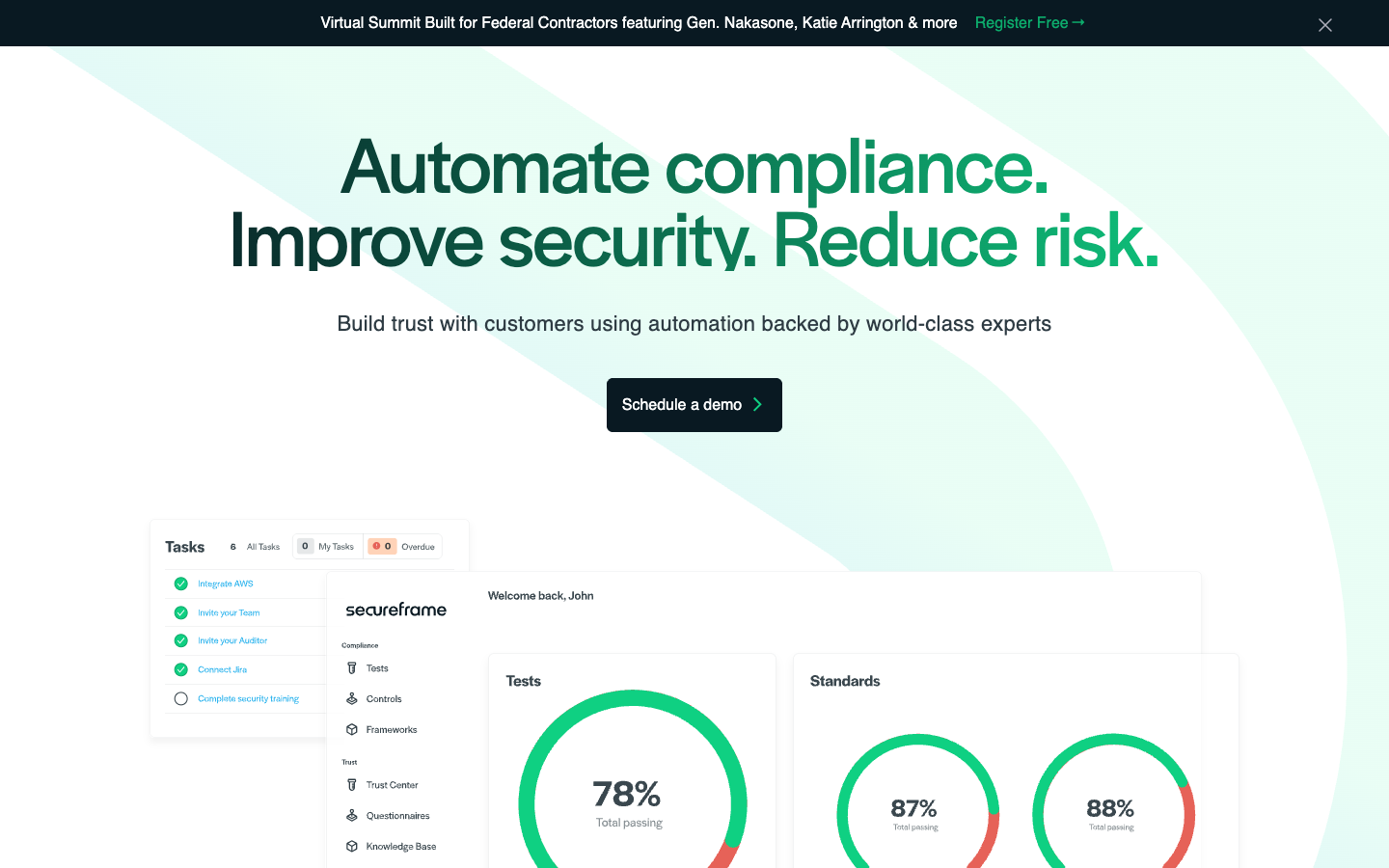
Secureframe is the mid-market compliance platform with a quietly large footprint: 6,000+ companies, 4.7/5 across 700+ reviews, and a support team that includes 30+ in-house compliance experts and former auditors. Trust center, questionnaire automation, and compliance automation are all bundled. Not the flashiest tool on this list, but the track record is real.
The product philosophy is similar to ComplyJet and Sprinto: automate evidence collection, keep controls current, make audit prep manageable. Secureframe AI streamlines tasks that used to require manual work. The trust center lets you share compliance status with buyers. Questionnaire automation handles inbound security reviews.
Where Secureframe sits in the competitive landscape: similar compliance depth to Vanta, smaller integration ecosystem, but some users find it more approachable to implement. Compared to ComplyJet: Secureframe does not publish pricing and uses a per-seat model, which means cost scales with headcount in a way that flat-rate platforms do not.
“
As a Security & Compliance Officer who has been using Secureframe for several years, I can confidently say it has been one of the most impactful investments we've made. What started as a tool to help us prepare for SOC 2 quickly became the central hub for managing our entire compliance lifecycle — and the customizable trust center is a feature I particularly appreciate.
★★★★★Security & Compliance Officer· SMB
Via G2 ↗Key features:
- Trust Center
- Questionnaire automation
- Secureframe Comply (automated evidence collection)
- Secureframe AI (task automation)
- Continuous monitoring
- Policy management
- Risk and vendor management
- 30+ in-house compliance experts on staff
Pros of Secureframe
- Proven track record: 6,000+ customers, 4.7/5 across 700+ reviews
- Broad framework coverage including FedRAMP and CMMC 2.0
- In-house compliance experts available for guidance
- Trust center, questionnaire automation, and compliance in one platform
Cons of Secureframe
- No public pricing: requires a demo call
- Questionnaire automation less advanced than Conveyor
- Trust center feature depth falls below SafeBase and Vanta’s Advanced tier
Pricing: Custom quote; market data suggests $6,000-$15,000+/year
Best for: Small businesses wanting a proven, full-stack compliance platform with a trust center included
9. 1up
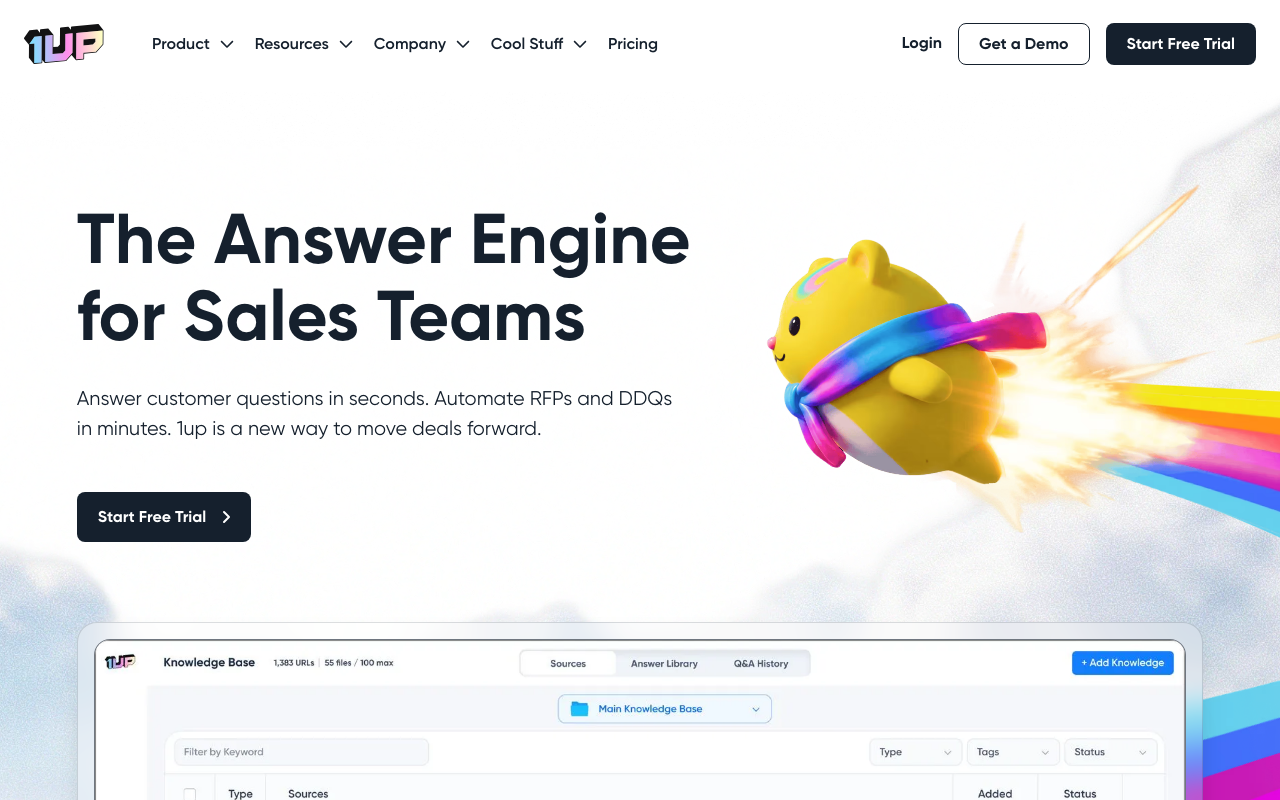
1up approaches trust centers from a different angle than every other tool on this list. It is built for sales and GTM teams, not security teams. The Answer Hub functions as a lightweight trust portal: buyers get 24/7 access to sourced, accurate answers about your product, pricing, and security posture. The underlying AI pulls from connected knowledge sources (Confluence, Google Drive, Notion, SharePoint) and generates responses with citations.
The questionnaire automation is solid: 1up handles RFPs, DDQs, and security questionnaires, and the browser plugin covers portal-based forms. The 4.9/5 rating across 23 reviews is the highest on this list. Implementation is fast and sales team adoption is high because sales reps actually want to use a tool that makes their job easier, which is not always true of security-team-first platforms grafted onto a sales workflow.
The key limitation is scope. 1up is not a compliance platform. There is no framework monitoring, no evidence collection, no audit readiness tracking. The trust portal does not show a live compliance status. If you need a full trust center with certifications and compliance documentation, 1up is a complement to a compliance platform, not a replacement for one.
“
1up has drastically cut down the time and effort to complete security questionnaires — many of which vary by client. The tool practically handles them for us now.
★★★★★Verified User· SMB · 11–50 employees
Via G2 ↗Key features:
- Answer Hub (24/7 buyer self-service portal)
- Security questionnaire and DDQ automation
- RFP automation
- Browser plugin for portal auto-fill
- Slack and Microsoft Teams integration
- Knowledge base connectors (Confluence, Google Drive, Notion, SharePoint)
Pros of 1up
- Highest rating on this list: 4.9/5 across 23 reviews
- Fast to implement; strong sales team adoption
- Strong questionnaire throughput across RFP, DDQ, and security formats
- Knowledge base stays current via connected sources
Cons of 1up
- Not a compliance platform: no framework monitoring, evidence collection, or audit readiness
- Trust portal is lightweight: no live compliance status or certification display
- Only 23 reviews on record (smaller sample than most tools here)
- Limited integrations (7 connectors vs. 300+ on compliance platforms)
Pricing: Custom quote; free trial available
Best for: Sales-led teams that need fast buyer questionnaire responses and a lightweight trust portal, without full compliance tooling
10. SecurityPal
SecurityPal occupies a unique position on this list: it is a managed service as much as it is software. The 12-hour questionnaire turnaround is backed by 150+ in-house certified security analysts operating 24/7. When the AI generates a response and it is borderline, a human reviews it. The trust center is part of the Customer Assurance Suite alongside vCISO services and vendor risk assessment.
For companies with high questionnaire volume and complex non-standard questions, SecurityPal’s hybrid model is genuinely compelling. Customers include Figma, MongoDB, Elastic, Grammarly, and Plaid. The unlimited questionnaire model removes the per-questionnaire cost anxiety that credit-based tools introduce.
The tradeoff is the managed service cost structure. SecurityPal almost certainly costs more than software-only alternatives. There is no public G2 rating on file. And if your questionnaire volume is low, paying for 150 analysts to be available around the clock does not make economic sense. This is the right call for fast-growing companies with enterprise deal flow and questionnaire volume to match.
“
SecurityPal's turnaround time, due diligence, and customer service is second to none. The combination of AI and human analysts means we never have to worry about a questionnaire sitting in a queue.
★★★★★Verified User· Enterprise
Via G2 ↗Key features:
- Branded trust center
- Security Questionnaire Concierge (12-hour completion)
- AI Copilot with human analyst review
- Knowledge Library with version tracking
- Vendor Assess and TPRM
- vCISO services
- Unlimited questionnaire model
Pros of SecurityPal
- 12-hour questionnaire turnaround backed by human analysts
- Enterprise customer roster: Figma, MongoDB, Plaid, OpenAI, 15+ Fortune 500
- Unlimited questionnaire model removes per-item cost risk
- vCISO services included
Cons of SecurityPal
- Managed service pricing: almost certainly above software-only alternatives
- Not a compliance platform: no framework monitoring or audit readiness
- No public G2 rating on file
- All pricing requires a sales conversation
Pricing: Custom quote; unlimited questionnaire model
Best for: Companies with high questionnaire volume and complex security reviews that need human expert backup, not just AI
How to choose trust center software
Standalone trust center or compliance platform?
If you are already on a compliance platform, use the built-in trust center. Vanta, Sprinto, ComplyJet, Secureframe, and Drata all include trust centers. Buying a standalone tool on top adds cost and creates two sources of truth for your security posture documentation.
The case for standalone (SafeBase, TrustCloud): your current compliance platform does not include a trust center, or you want the best-in-class buyer portal experience and your existing platform’s offering falls short.
Question to ask: does my compliance platform include a trust center? If yes, use it before buying something separate. If no, SafeBase or TrustCloud are the strongest standalone options.
Best trust center software for repetitive questionnaires: what to look for
If questionnaires are your primary bottleneck, the trust center portal is only half the problem. You also need a tool that actively reduces the manual work of answering each one.
Look for: AI that pre-fills from your own documentation (not generic templates), a browser extension for portal-based questionnaires, and a knowledge library that updates automatically as your documentation changes. Conveyor leads here, with 95%+ AI accuracy and a self-healing knowledge library. For volume so high that AI alone is not enough, SecurityPal’s human-backed 12-hour SLA removes the risk of AI errors reaching the prospect.
The test: the best trust center software for repetitive questionnaires is the one that handles the repetitive part for you, not just stores your answers.
Question to ask: how many questionnaires do you receive per month, and how many are portal-based vs. spreadsheet-based? That determines whether you need Conveyor’s browser extension, SecurityPal’s managed model, or a simpler bundled tool.
Are you buying compliance tooling at the same time?
If yes: prioritise a compliance platform that includes a trust center. Getting compliant and building your trust center as one project is more efficient than doing them separately. ComplyJet, Vanta, and Sprinto are the strongest picks at different price points.
If you are already compliant and adding a trust center: SafeBase is the standalone specialist. If the bottleneck is questionnaire automation specifically, Conveyor or 1up solves a more targeted problem.
Startup, scaling, or enterprise?
Startup (seed to Series A, 1-50 people): ComplyJet ($5K-$8K flat), TrustCloud (free tier for under 20 people), or Sprinto (~$6-8K). Prioritise flat or low pricing, fast setup, and a team that guides you rather than leaving you with a ticket queue.
Scaling (50-500 people): Vanta (enterprise-grade, 400+ integrations), Conveyor (questionnaire automation at volume), or Secureframe (6,000+ customer track record). Prioritise automation, integration depth, and questionnaire throughput.
Enterprise (500+ people): SafeBase/Drata (deepest trust center), OneTrust (multi-regulatory), or SecurityPal (managed questionnaire plus trust center). Prioritise human backup, enterprise network recognition, and global compliance coverage.
Free Demo
Ready to close that enterprise deal?
ComplyJet gets you compliant and your trust center live. Flat pricing, no surprises.
Frequently asked questions
What is trust center software?
Trust center software provides a public or gated portal where prospects, customers, and auditors can access your security posture, compliance certifications (SOC 2, ISO 27001), policies, and other documentation without emailing your security team for every request. Some tools are standalone portals. Others are built into compliance automation platforms. The best ones also automate questionnaire responses using your documentation as the knowledge base.
What should a trust center include?
At minimum: your certifications and attestations (SOC 2, ISO 27001), key security policies, a penetration test summary, and a way for visitors to request access to more sensitive documents under NDA. More advanced trust centers include real-time compliance status, an AI chatbot for buyer questions, and analytics on who viewed what. The difference between a basic portal and a useful trust center is whether it reduces your security team’s workload or just moves the same documentation online.
Do I need separate trust center software, or is it included in compliance tools?
Most compliance automation platforms (Vanta, ComplyJet, Sprinto, Secureframe, Drata) include a trust center as part of the platform. You only need standalone trust center software if your existing compliance tool does not include one, or if your questionnaire volume is high enough to justify dedicated automation tooling like Conveyor or SecurityPal.
How much does trust center software cost?
Bundled into compliance platforms: typically $5,000-$15,000/year for the full platform. ComplyJet’s flat rate is $5K-$8K/year. Vanta and Sprinto both start around $6K. Standalone trust center tools like SafeBase are custom-priced. Questionnaire-focused tools like Conveyor start at $9,600/year. TrustCloud offers a free tier for companies under 20 employees. Enterprise tools like OneTrust start at $10,000/year and scale significantly.
Is a trust center the same as a security portal?
These terms are used interchangeably. “Security portal” is the older term. “Trust center” has become the dominant category name as the tools evolved to include compliance status, buyer analytics, and questionnaire automation. Functionally they are the same thing: a place where buyers can access your security information without emailing your team.
Can I build my own trust center instead of buying software?
Yes, some companies use Notion or a static web page to share security documentation. It works at very early stage with minimal questionnaire volume. The trade-offs: no NDA gate automation, no access analytics, no questionnaire AI, and no continuous compliance status updates. Most teams outgrow DIY solutions within 6-12 months of their first enterprise deal. The manual overhead of keeping documentation current and tracking who has seen what accumulates faster than it looks on day one.
Final thoughts
Trust centers have moved from a nice-to-have to a standard expectation in enterprise B2B procurement. The question is no longer whether to have one, but which tool makes sense for where you are right now.
If you are pursuing your first compliance certification and want to share it with prospects, a compliance platform with a built-in trust center is the right starting point. ComplyJet, Sprinto, and Vanta all cover this in one product. If you have compliance handled and the bottleneck is questionnaire volume, Conveyor or SecurityPal solves a more specific problem.
The distinction that runs through every choice in this category: you can pick the safe, well-known option, or you can pick the one that actually fits how you work. For early-stage teams, those two answers rarely point to the same place.
Free Demo
First certification? ComplyJet is built for you.
Flat pricing from $5K, 350+ integrations, and a team that guides you from kickoff to audit close.