.svg)

A Series B SaaS company I knew had a $2M enterprise contract on the table. The security team on the other side ran their standard procurement review. They opened the SOC 2 report, scanned the auditor’s name, and flagged it immediately.
Why? Because there was no AICPA peer review on record. The control language was templated. Generic phrases repeated across 80 controls with no evidence of actual testing.
The report had cost $2,800 and the contract was worth $2M, but the deal did not close.
This is not some hypothetical story. It is the 2026 reality of a market flooded with audit mills (firms issuing SOC 2 reports with minimal actual attestation work).
The AICPA formally opened investigations into non-compliant vendors in 2025, coordinating with state boards of accountancy on unlicensed practitioners. And yet buyers keep getting burned because most of the advice they get on choosing a SOC 2 auditor is too shallow.
In this article, we’ll tell you how to choose a SOC 2 auditor by covering the mistakes buyers actually make, the pricing realities nobody publishes, the credential signals that separate real auditors from rubber-stampers, and the exact questions that expose a bad firm in a 30-minute call.
Already preparing for your audit? Start your SOC 2 free trial with ComplyJet and walk into your audit ready from day one.
Here is what the rest of this guide covers, condensed for fast reference.
What to Know Before You Choose?
- A SOC 2 auditor must be a licensed CPA firm operating under SSAE 18. No exceptions.
- SOC 2 is an attestation and not a certification. Any vendor using the word “certified” for SOC 2 does not understand the framework.
- Choosing a SOC 2 auditor is not like hiring a contractor. The wrong choice can produce a report that opens you to regulatory scrutiny or forces a full re-audit at your own expense.
- The AICPA requires CPA firms to complete a peer review every three years. That result is public. Check it before you sign anything.
- Audit mill reports have been rejected in enterprise procurement reviews. A $2,000 audit is not a bargain. It is a liability.
- Auditor selection directly affects your audit timeline, your evidence workload, and whether your report holds up in real-world sales cycles.
Tip: If a firm’s proposal arrives without asking about your cloud infrastructure, system architecture, or number of products in scope, you are looking at a templated quote. Move on.
Use these basics as your first filter, because the next step is understanding what a SOC 2 auditor actually does and why their role matters.
Who Is a SOC 2 Auditor and Why Does It Matter?
A SOC 2 auditor is a licensed CPA firm that conducts an independent attestation engagement under SSAE 18, specifically AT-C sections 105 and 205.
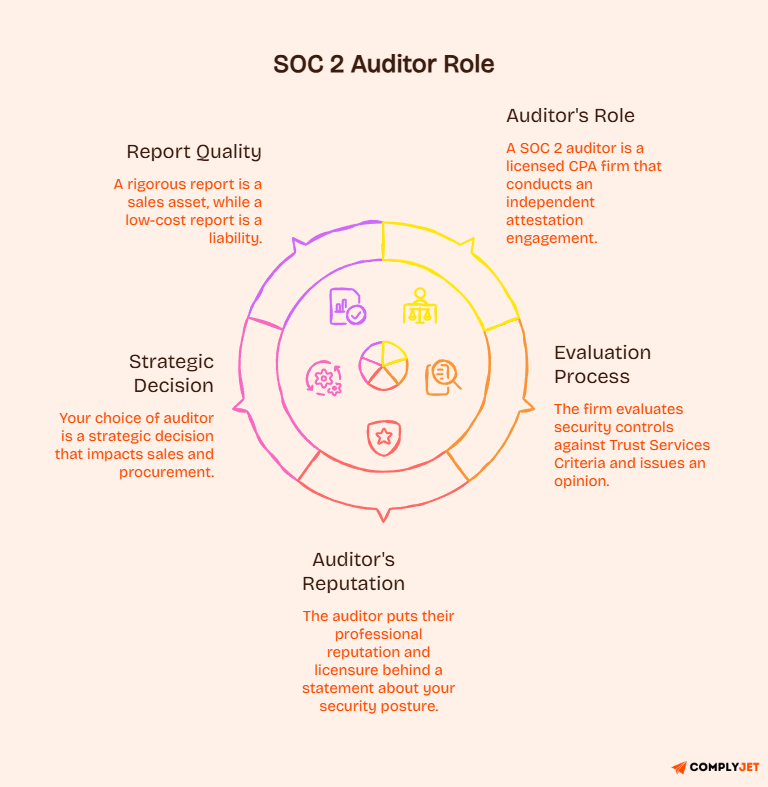
The firm evaluates your security controls against the Trust Services Criteria and issues an opinion on whether those controls are designed correctly (SOC 2 Type 1) and are operating effectively over time (SOC 2 Type 2).
The distinction matters more than most people realise. The auditor is not only processing paperwork. They are putting their professional reputation and licensure behind a statement about your security posture.
If they get that wrong, they face consequences with their state board of accountancy, with the AICPA, and potentially with the clients who relied on their work.
Your choice of auditor is a strategic decision. The report that comes out of a rigorous, well-staffed engagement is a sales asset that closes enterprise deals and moves procurement reviews forward pretty fast.
A report from a low-cost shop that rubber-stamps your controls is actually a liability waiting to surface exactly the moment you need it most.
Tip: Before you shortlist any firm, read our guide to understanding your SOC 2 report. Knowing what a high-quality report looks like makes it much easier to evaluate what you are being sold.
Once you understand that the auditor’s name carries real commercial weight, the next risk becomes clear: not every firm signing SOC 2 reports is doing real audit work.
The Audit Mill Crisis: What Goes Wrong in 2026
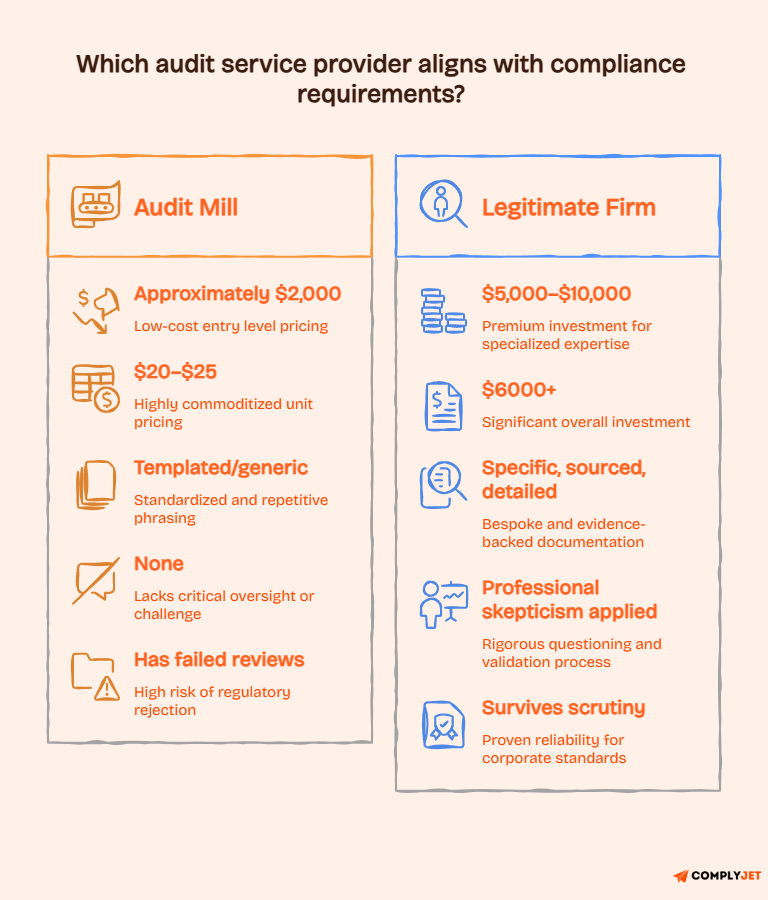
The audit mill problem is not new, but it has gotten more visible. Some firms are currently charging around $2,000 for a complete SOC 2 report. A standard SOC 2 engagement covers 80 to 100 controls. Do the math, and that works out to roughly $20 to $25 per control.
A legitimate auditor reviewing a single control cluster can spend hours gathering and verifying evidence. At $20 per control, there is no room for that work.
What you get from an audit mill is a templated report. Generic testing language. Minimal inquiry. No pushback on gaps.
The report looks like a real SOC 2 report. It has the right formatting and the right headings. But when an enterprise security team or a sophisticated procurement reviewer looks at the testing procedures, the language is vague, the control descriptions are generic, and the depth simply is not there.
According to SC&H Group, audit mill reports have failed enterprise procurement security reviews. That failure happens at the worst possible time. Like when you are deep in a deal, and your customer’s security team is doing its due diligence.
Check the latest SOC 2 compliance news to stay current on audit industry developments.
What a Legitimate SOC 2 Audit Actually Looks Like?
A legitimate SOC 2 engagement starts with detailed scoping conversations before a quote is even issued. The auditor will ask about your cloud provider, your infrastructure, your products in scope, your third-party subservice organisations, and which Trust Service Criteria apply. They need this information to staff the engagement correctly and price it accurately.
During fieldwork, a quality auditor asks the hard questions and requests additional evidence when something is unclear. They also probe the design of your controls.
If your audit felt easy with little pushback, no difficult questions, and no requests for evidence beyond a basic checklist, that is definitely not a good sign.
A legitimate firm also has a formal internal review process. The AICPA review process alone, covering technical review, QA, and signer approval, takes three to four weeks on top of fieldwork.
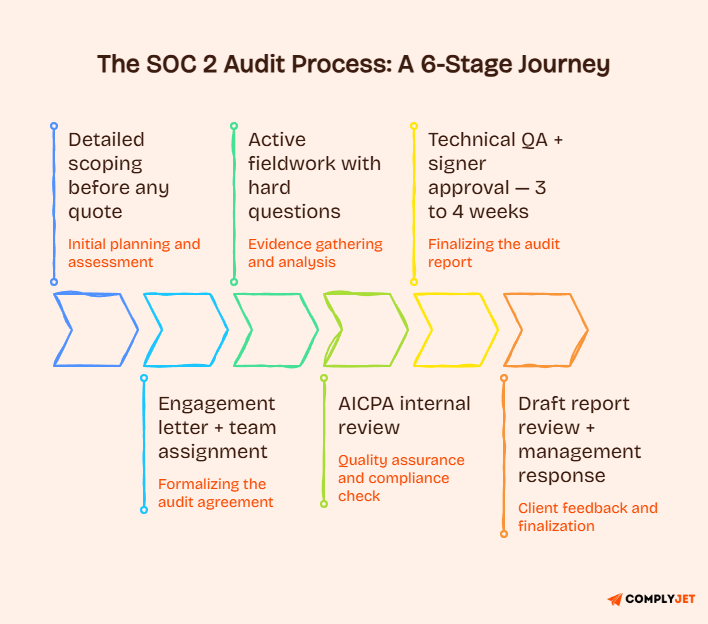
That timeline is a useful sanity check. Any firm promising a complete Type 2 report in under two months is either cutting corners or misrepresenting the framework.
Note: The Identity Theft Resource Centre’s 2025 Annual Data Breach Report found that 70% of breach notices did not include attack information, up from 65% in 2024 and 45% in 2023. That matters because buyers are being asked to assess vendor risk with less useful breach information, making third-party assurance documents like SOC 2 reports more important.
The type of audit you pursue changes everything about which auditor fits. If you are new to this, the SOC 2 Type 1 vs Type 2 decision is worth understanding before you start conversations with firms.
A rigorous process starts with a qualified firm, which means you need to know exactly what legally qualifies someone to perform a SOC 2 audit.
Legal Qualifications of a SOC 2 Auditor
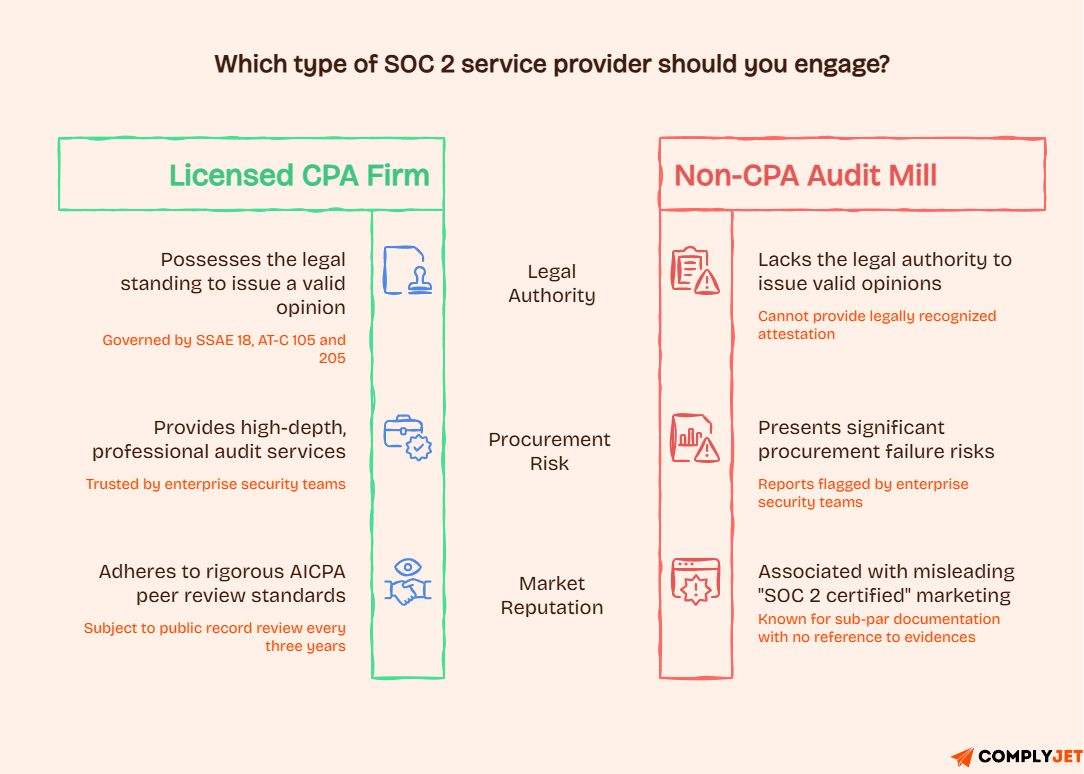
Only a licensed CPA firm can issue a valid SOC 2 report. This is governed by SSAE 18, the attestation standard under which SOC 2 engagements are conducted.
A licensed CPA must sign the final attestation opinion. Non-CPA vendors, regardless of how large their team is or how sophisticated their software may be, cannot produce a valid SOC 2 opinion. State boards of accountancy enforce this.
This matters for a practical reason. When your enterprise customer receives your SOC 2 report, their security or legal team can look up the signing firm. They can verify licensure, check peer review status, and assess the firm’s reputation.
If the firm is not a recognised licensed CPA, that review process will surface the problem. Choosing an unqualified vendor means the report does not pass that verification.
What the AICPA Requires Every SOC 2 Auditor to Hold?
The AICPA sets three baseline requirements for any firm conducting a SOC 2 engagement.
First, the firm must be accepted by the AICPA as a qualified assessor, with mandatory peer review every three years.
Second, a state-licensed CPA must sign the final report, even if technical staff conducted the actual testing.
Third, the firm must maintain independence, meaning no financial interests in the assessed company and no individual assessor relationships that compromise objectivity.
These are professional standards. A firm that fails any of these three requirements is conducting the engagement outside of AICPA professional standards, and the resulting report carries real legal and commercial risk.
CPA, CISA, CISSP: What Each Credential Signals
The CPA license is the legal requirement. Without it, a firm cannot sign your report. But CPA alone does not tell you whether a team can audit a modern cloud-native SaaS environment effectively.
The CISA credential, issued by ISACA, is the most directly applicable technical credential for SOC 2 fieldwork. Auditors holding a CISA have demonstrated competence in information systems auditing, control design, and IT risk assessment.
The CISSP, issued by ISC2, goes deeper into infrastructure and architecture knowledge. A team with only CPA credentials and no CISA or CISSP holders may struggle with the technical depth required to audit Kubernetes clusters, CI/CD pipelines, or cloud-native access management systems.
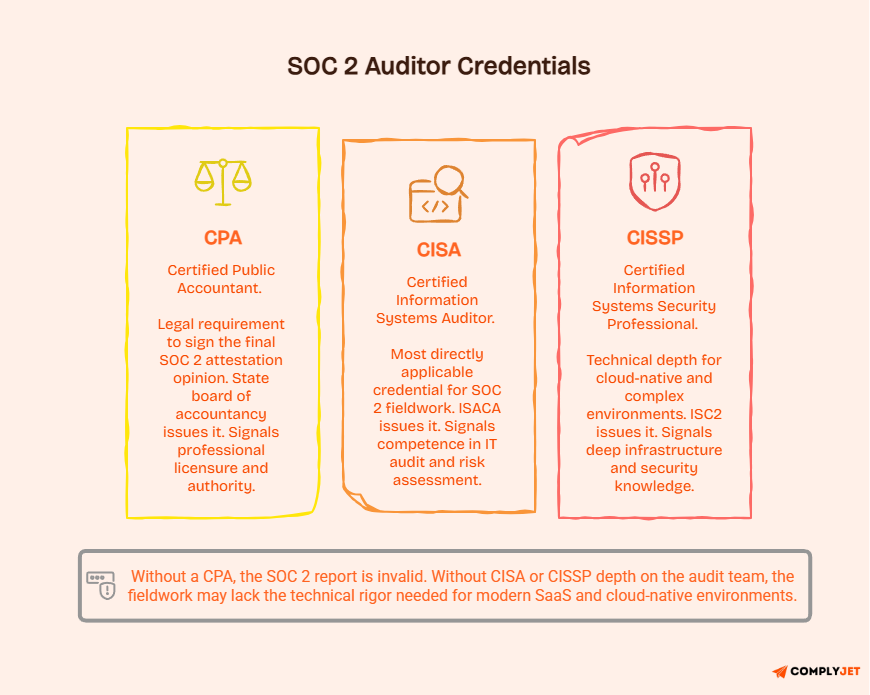
Look at the credential composition of the team that will actually be working on your engagement, not just the partner who signs the report.
How to Check a Firm’s AICPA Peer Review Status?
The AICPA requires every licensed CPA firm to complete a peer review inspection every three years. The results are rated as Pass, Pass with Deficiencies, or Fail. These ratings are publicly searchable in the AICPA Program database.
Before you sign any engagement letter, look up every firm you are evaluating. A Pass result means the firm met quality standards on its most recent review. Pass with Deficiencies is a red flag and warrants direct questions about what the deficiency covered and what was remediated.
No record at all is an immediate disqualifier: it either means the firm has not been reviewed or is not enrolled in the program.
Founder’s tip: Run this check before you even take a sales call with a firm. If their record is not clean, you know before investing your time in their pitch.
Once the firm clears the legal and peer review filters, you can evaluate the practical factors that determine whether they are the right fit.
Key Considerations to Choose a SOC 2 Auditor
Choosing an auditor is not a single-variable decision. You are evaluating a professional services relationship that will affect your company for years. Your SOC 2 report is valid for one year, which means this is an annual process. The firm you pick now is the firm you will likely work with again next year.
The considerations below are not equally weighted for every company. A pre-Series A startup with a three-person engineering team has different needs from a 200-person SaaS company with enterprise healthcare customers.
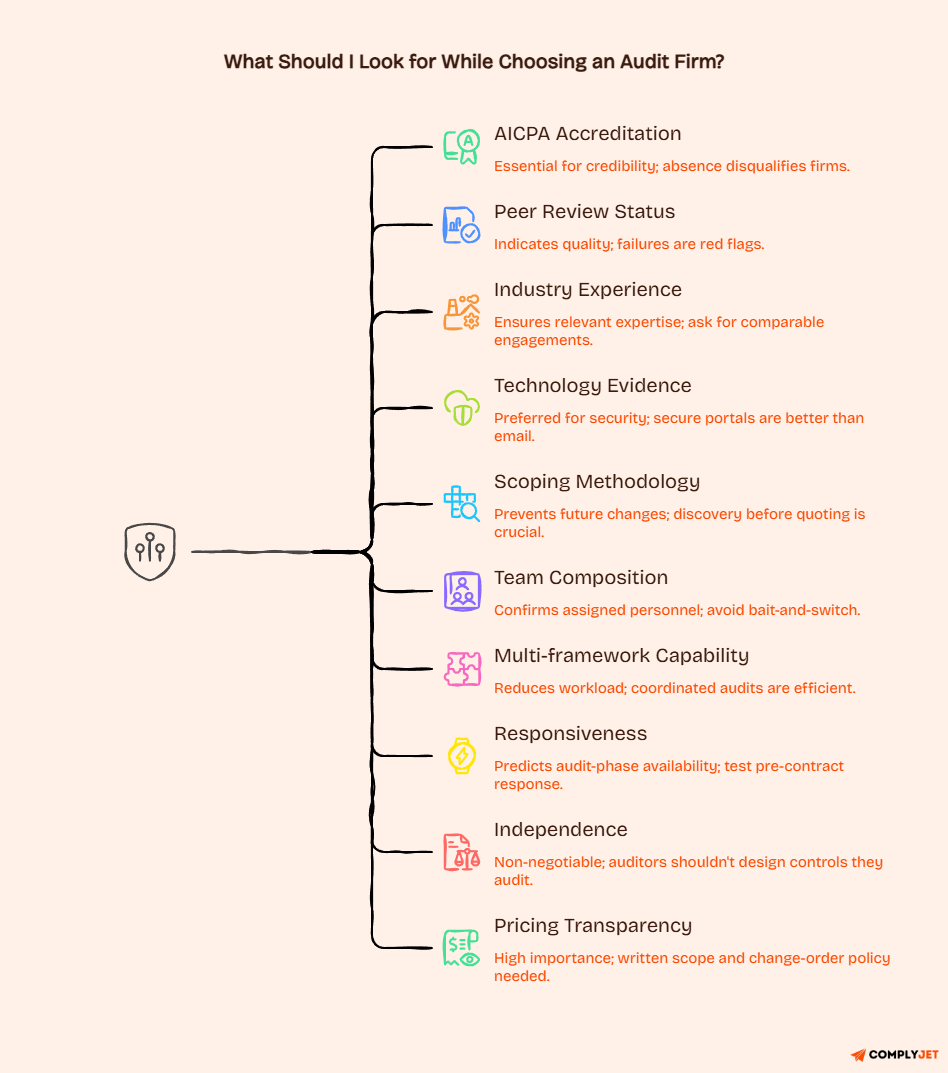
Work through these in the order that matters most for your specific situation.
1. AICPA Accreditation: The Non-Negotiable First Filter
Before any other evaluation, verify that the firm is a licensed CPA firm enrolled in the peer review program of AICPA. This is the hard gate. No accreditation means no valid report, and no further evaluation is needed.
This step filters out a growing number of non-CPA vendors who package compliance software and advisory services under branding that implies audit authority. If the firm is not on the peer review database, stop there.
2. Peer Review Status: The Most Objective Signal
After confirming enrollment, check the actual rating. A Pass rating with no recent deficiencies is your baseline expectation for any firm you consider seriously.
The peer review inspection also tells you something about how the firm manages quality internally. Firms that consistently earn clean peer review ratings maintain formal QA processes on their engagements. That discipline shows up in how they staff, document, and review your audit.
3. Industry and Tech Stack Experience
A SOC 2 auditor who has never audited a SaaS company will spend your engagement learning your environment from scratch. That is the time you are paying for, and it produces a less rigorous outcome.
Ask specifically how many companies in your vertical and at your stage the firm has audited in the past two years. Ask whether they have experience with your cloud provider. A firm that has audited 40 AWS-hosted SaaS companies will understand your evidence artifacts, your logging setup, and your access management architecture much faster than one that primarily works with on-premises enterprise environments.
4. Evidence Collection Technology
Modern SOC 2 audits involve structured evidence requests across dozens of systems. How a firm collects, organises, and tracks evidence directly affects how smooth or painful the engagement is for your team.
Firms using secure evidence portals with organised request tracking, integration support, and clear status visibility are easier to work with than those still running evidence collection over email threads.
Ask whether the firm integrates with your existing compliance reporting stack. The answer tells you whether your audit will feel collaborative or like a document dump.
Why this matters: Poor evidence management is one of the leading causes of audit delays and last-minute scrambles. Platforms like ComplyJet automate evidence collection from over 100 integrations, so you spend your time on control work, not on chasing screenshots.
5. Scoping Methodology: What They Ask Before Quoting
A quality auditor will not send you a proposal without first asking a long list of questions about your environment. They need to understand your cloud provider and architecture, the number of products and services in scope, your third-party subservice organisations, whether you are on-premises, cloud, or hybrid, and which Trust Services Criteria are relevant.
A firm that sends a proposal without this discovery process cannot accurately estimate the work, staff the engagement appropriately, or protect you from mid-project change orders. Poor scoping upfront is the primary cause of cost overruns in SOC 2 engagements. If their first response to your inquiry is a price, that is a problem.
6. Team Composition and Partner Involvement
Some firms use a bait-and-switch model where a senior partner runs the sales conversation and a junior staff member does all the actual audit work. This is more common than it should be.
Ask directly who will be assigned to your engagement. What are their credentials? How long have they been with the firm? Will a senior partner review the testing procedures, or just sign the final report? The quality of fieldwork is determined by the people doing it, not by the name on the letterhead.
How Do Auditors Evaluate SOC 2 Effectiveness?
Auditors evaluate SOC 2 effectiveness by testing whether your controls are designed correctly and, for Type 2, whether they operated consistently over the observation period. That means they are not just checking that a policy document exists. They are verifying that access reviews actually happened on schedule, that your monitoring captured the events it should have, and that exception handling was documented when something went wrong.
The auditor’s testing procedures are what determine the quality of the report. A generic test like “verified control was in place” with no description of how it is is a sign of low-effort work. A strong test procedure describes what evidence was reviewed, what population was sampled, and what conclusion was drawn. That specificity is what makes a report defensible.
7. Multi-Framework Capability
If your roadmap includes ISO 27001, HIPAA, HITRUST, or PCI DSS alongside SOC 2, an auditor with multi-framework capability can coordinate evidence collection across all of them simultaneously. This matters because the evidence requirements across these frameworks overlap significantly. Collecting evidence once and mapping it across frameworks can reduce your total compliance workload by up to 40%, according to Marcelo Labs.
Selecting a single-framework auditor now and then bringing in different firms for each subsequent standard means re-running evidence collection from scratch each time. These compounds are fast as your compliance program matures. Our comparison of ISO 27001 vs SOC 2 covers exactly where the control overlap is and how to think about sequencing.
8. Communication Responsiveness
Here is a simple test. Send a detailed inquiry to each firm you are evaluating and measure how long it takes to get a substantive response. Pre-contract responsiveness is the single best predictor of how available your audit team will be during critical evidence collection windows.
Slow responders before you sign almost always become slow responders during the engagement itself. When you are trying to close an evidence request two days before a deliverable deadline, that communication gap is a real operational risk.
9. Independence: The Line Auditors Cannot Cross
AICPA independence rules prohibit an auditor from designing or implementing the controls they will subsequently audit. A firm that offers to write your policies, build your controls, or do the compliance work itself and then audit the result is violating professional standards. The independence breach renders the resulting report invalid under AICPA guidelines.
This is a real issue. Some firms blur the line between compliance consulting and audit work deliberately. If a firm pitches you on helping you build your SOC 2 program and then auditing it, those two services must be completely separate entities, or that arrangement is a structural independence violation. Your SOC 2 controls documentation is your responsibility. Your auditor verifies it.
10. Pricing Transparency and Change Order Policy
A reliable firm will provide a written quote that clearly defines the scope of work, what is included, and what will trigger a change order. Ask explicitly about the change order policy before signing. A firm that cannot answer this question has not thought carefully about its scoping process.
Vague scope definitions are where mid-engagement cost surprises originate. If the proposal does not specify the number of controls in scope, the criteria included, or the observation period for a Type 2, you are missing information that directly affects the final cost.
Also, a strong SOC 2 audit readiness process built before the audit window starts significantly reduces that internal burden.
These criteria help you assess individual firms, but you still need to match the type of audit firm to your company’s stage, budget, and customer expectations.
The Three SOC 2 Auditor Tiers: Pick the Right Fit
Not every SOC 2 auditor serves every stage of the company. The market breaks down into three distinct tiers. Matching your stage to the right tier affects cost, timeline, reporting quality, and the commercial signal your report sends.
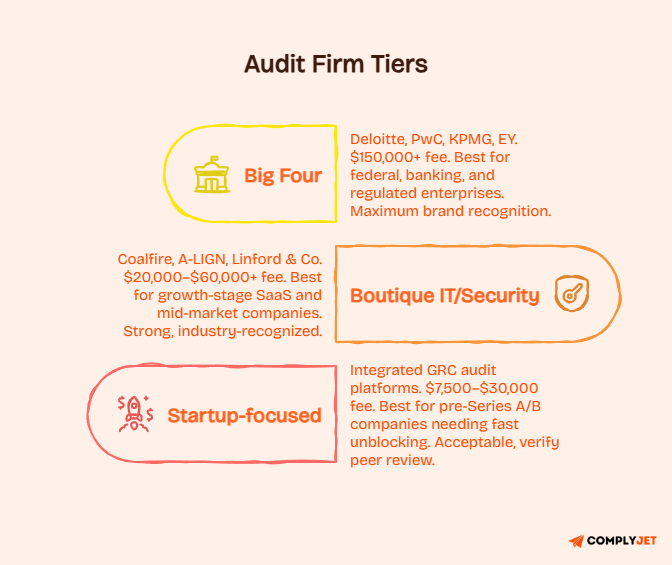
Understanding which tier fits your situation is one of the most practical decisions you will make in the auditor selection process.
Big Four: Premium Assurance for Enterprise Deals
Deloitte, PwC, KPMG, and EY issue SOC 2 reports, but their fees reflect their brand and their client base. Expect to pay $150,000 or more for a Big Four engagement. For most startups and mid-market SaaS companies, this is not the right fit.
Where Big Four makes sense: companies selling into highly regulated industries like banking or the federal government, where a Big Four signature on the report is a meaningful commercial differentiator. In those environments, procurement teams sometimes specifically require a report from a recognised firm of that tier.
Boutique IT/Security Firms: The Mid-Market Sweet Spot
Firms like Coalfire, A-LIGN, Linford and Co, and BARR Advisory occupy the middle tier. They have deep technical staff, established audit methodologies, and significant SOC 2 experience. Pricing for a Type 2 engagement typically ranges from $20,000 to $60,000 or more, depending on scope.
For most growth-stage SaaS companies pursuing SOC 2 to open enterprise sales, this tier is the right fit. You get experienced technical staff, rigorous fieldwork, and a report that holds up to enterprise procurement scrutiny, at a price that fits a real budget.
Startup-Focused Platforms: Speed, Integration, Price
Firms and integrated platforms targeting early-stage companies can complete a Type 1 engagement in weeks and a Type 2 in the $7,500 to $30,000 range. These firms typically integrate with compliance automation software, which reduces evidence collection time and lowers the overall cost of the engagement.
The tradeoff is that some of these firms are newer with shorter track records. Ask about their peer review history and how many comparable engagements they have completed. The best SOC 2 compliance software review covers how these platforms compare for managing evidence on your side of the audit process.
Choosing the right tier is especially important for CISOs, because they need a report that stands up not just to auditors, but to boards and enterprise buyers.
What CISOs Get Wrong When Choosing a SOC 2 Auditor?
The most common mistake CISOs make is treating the auditor selection as a procurement exercise rather than a strategic decision. They issue an RFP, collect three proposals, compare prices, and pick the middle one. That process surfaces cost, but it does not surface quality.
The second most common mistake is optimising for speed. Under pressure from sales teams who need a report to close deals, security leaders sometimes pick whoever can start fastest.
Speed matters, but the timeline difference between a quality boutique firm and a faster startup-focused firm is often smaller than it appears. Starting a few weeks earlier with a weak auditor can cost you months later when a procurement reviewer flags your report.
How CISOs Should Structure the Auditor Evaluation
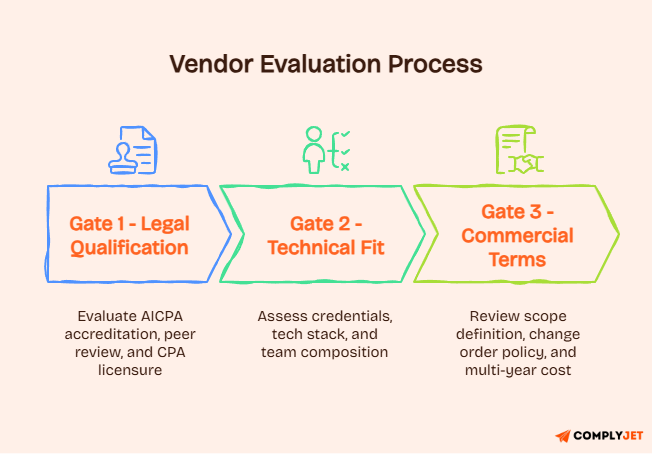
Structure your evaluation around three gates.
First, verify legal qualification: AICPA accreditation and a clean peer review.
Second, assess technical fit: credentials, tech stack experience, and team composition for your specific environment.
Third, evaluate commercial terms: scope definition, change order policy, and long-term multi-year cost.
Request at least two client references from companies at a similar stage and in a similar vertical. Talk to those references specifically about the quality of questions during fieldwork, the responsiveness of the team during evidence collection, and whether any change orders came in after signing.
A well-structured SOC 2 gap analysis before you start auditor conversations puts you in a much stronger position. You know your own environment, your control gaps, and your evidence readiness.
That knowledge helps you evaluate whether an auditor’s scoping questions are shallow or genuinely thorough.
A better CISO evaluation starts with structure, and that structure becomes even stronger when it accounts for the risks specific to your industry.
Auditor Selection by Industry: SaaS, Fintech, Health
Your industry shapes what you need from an auditor. The Trust Services Criteria are consistent across industries, but the control environment, the relevant risks, and the commercial expectations from your buyers differ significantly depending on your vertical.
This is not about finding an auditor who will go easy on industry-specific controls. It is about finding one who understands your environment well enough to audit it rigorously.
How to Choose a SOC 2 Auditor for Your SaaS Company?
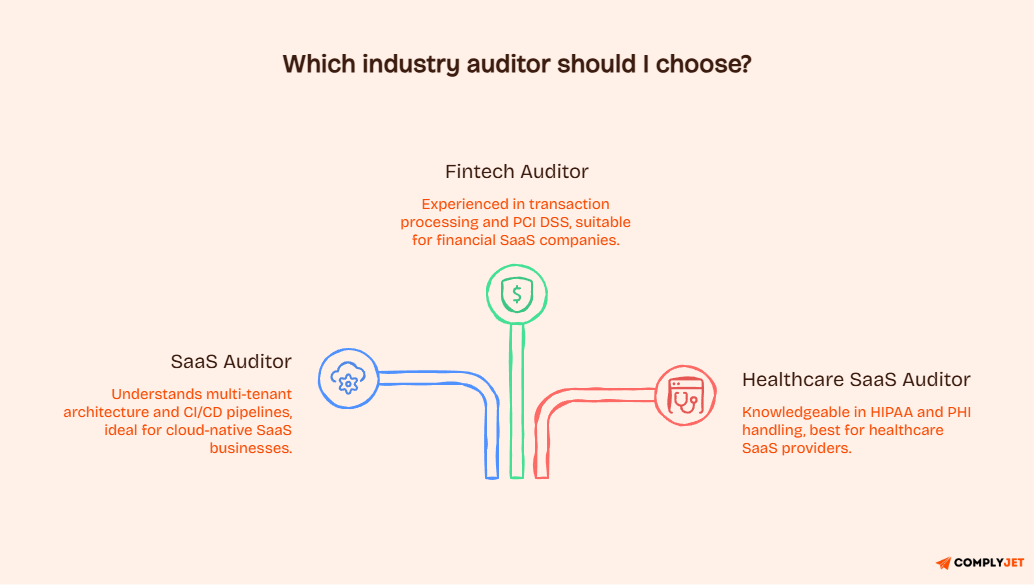
SaaS companies typically operate multi-tenant architectures on cloud infrastructure with continuous deployment cycles.
Your auditor needs to understand how changes move through your CI/CD pipeline, how tenant isolation is enforced at the infrastructure layer, and how access is managed across a distributed engineering team.
Ask specifically whether the firm has audited multi-tenant SaaS companies on your cloud provider.
Ask how they approach testing for availability and confidentiality controls in a continuous deployment environment. If they have not worked with companies like yours, they will spend your engagement learning instead of testing.
Understanding your SOC 2 compliance requirements before these conversations helps you ask smarter questions and evaluate the depth of their answers.
Fintech Auditor Requirements: Financial Controls First
Fintech companies carry additional regulatory exposure. Enterprise financial customers often require SOC 2 to coexist with PCI DSS and sometimes SOX alignment. An auditor with only SOC 2 experience may not understand how to scope an engagement that also satisfies your customers’ PCI requirements or how your transaction processing controls map across frameworks.
Look for firms with demonstrable PCI DSS and fintech experience. Ask whether they can coordinate a multi-framework engagement. The evidence overlap between SOC 2 and PCI is real, and a coordinated audit saves significant internal resources.
Healthcare SaaS: When HIPAA Expertise Is Non-Negotiable
If your product touches protected health information, your enterprise buyers will expect your auditor to understand HIPAA technical safeguards. SOC 2 does not replace HIPAA, but the two frameworks overlap substantially. Your auditor should be able to describe exactly where the control requirements align and where additional HIPAA-specific testing is needed.
Ask directly whether the firm has conducted HIPAA-focused SOC 2 engagements. Ask whether their team includes members with healthcare compliance experience. An auditor unfamiliar with PHI handling requirements will miss context that matters to your healthcare buyers.
Industry fit gives you context, but when you are actively comparing firms, you still need a simple checklist to keep the decision objective.
The 12-Point Checklist to Choose a SOC 2 Auditor
Use this when you are actively evaluating firms. Each item is a binary check or a direct question to ask during the sales process.
- Verified as a licensed CPA firm enrolled in the AICPA peer review
- Peer review rating is Pass with no recent deficiencies
- Can provide a verifiable count of SOC 2 engagements in your industry
- Team includes CISA or CISSP credential holders, not only CPAs
- Asks detailed architecture and scoping questions before issuing a quote
- Clearly names the senior team member assigned to your engagement
- Uses a secure, structured evidence collection platform
- Can describe their testing methodology for your specific control environment
- Has multi-framework capability if you have future ISO or HIPAA requirements
- Provides a written scope with explicit change order policy
- Responds to your initial inquiry within 24 to 48 hours
- Can provide two to three client references at a comparable stage
Red Flags That Should End the Conversation Fast
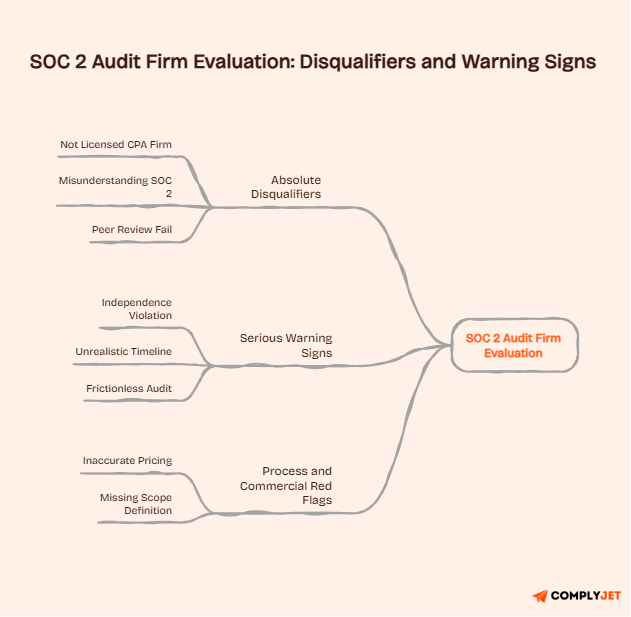
Some indicators are immediate disqualifiers. Others are serious warning signs that warrant direct follow-up questions. Know the difference before you enter conversations.
1. Absolute Disqualifiers
Any firm that is not a licensed CPA firm enrolled in the peer review program of AICPA cannot produce a valid SOC 2 opinion. Full stop, end of conversation.
Any firm that uses the word “certification” to describe SOC 2, calls themselves a “SOC 2 certifier,” or markets a “SOC 2 certification program,” does not understand the framework they are selling.
Any firm with a Fail or Pass with Deficiencies rating on the peer review of AICPA’s public database requires extensive explanation and is almost certainly a firm to avoid.
2. Serious Warning Signs
A firm that offers to design or write your controls and then audit them is violating AICPA independence requirements. Even if they explain it as a “readiness phase” bundled with the audit, the structural conflict remains. Per AICPA guidelines, auditors can provide hints toward solutions but cannot design or perform the controls they subsequently attest to.
A firm that quotes a Type 2 completion in under two months is misrepresenting what is possible. The minimum observation period for a Type 2 is three months, and a realistic first-time engagement runs six to fifteen months from kickoff to final report.
A frictionless audit experience with no difficult questions and no evidence requests beyond a basic checklist is a serious warning sign, not a positive. Quality auditors push back. They ask follow-up questions. They exercise professional scepticism.
3. Process and Commercial Red Flags
A firm that issues a proposal without asking detailed scoping questions about your environment cannot accurately price the engagement. That proposal is either underscoped, which means change orders later, or overscoped, which means you are paying for work that will not happen.
Any proposal that does not explicitly define the scope of work, the observation period, the included criteria, and the change order policy is missing information you need before signing.
Request a revised proposal with those specifics before moving forward.
Red flags are useful in theory, but the safest move is to verify the firm’s credentials yourself before signing anything.
How to Verify Your SOC 2 Auditor’s Credentials?
Verification takes about ten minutes and protects you from a category of risk that has become increasingly common in the SOC 2 market.
- Start with the AICPA public database. Search for the firm by name. Confirm that they appear in the database, note their most recent review date, and check the rating. A current Pass rating with a review date within the past three years is your baseline expectation.
- Next, confirm the firm’s CPA licensure with the relevant state board of accountancy. Most state boards maintain searchable online license verification databases. This step confirms that the firm is actively licensed and in good standing.
- Finally, ask the firm directly for references from two or three engagements at companies in your vertical.
- Follow up with those references and ask specifically about the quality of testing, communication responsiveness, and whether any surprises came up after signing.
Once you know the auditor is legitimate, the next question is whether their pricing makes sense for your scope, stage, and risk profile.
What SOC 2 Auditors Actually Cost in 2026?
Cost varies significantly across firm tiers and engagement types. These are realistic 2026 market ranges based on data from multiple sources, including Marcelo Labs, TrustCloud, and Linford and Co.
- Type 1 audit fees run from $5,000 to $20,000 for most companies, and can reach $60,000 for larger or more complex organisations.
- Type 2 fees start around $7,500 for startup-focused platforms and climb to $30,000 for those firms at the upper end. Boutique IT and security firms typically charge $20,000 to $60,000 or more for Type 2. Big Four engagements start at $150,000.
- Readiness assessments, which are optional but recommended for first-time audits, typically run $3,000 to $15,000.
- Total first-year all-in cost for a startup, including readiness assessment, audit fees, and compliance tooling, realistically lands between $25,000 and $70,000. For enterprise companies, the total can exceed $200,000.
These numbers are for the audit itself.
Your internal resource cost, meaning the engineering and security team time spent on evidence collection, control remediation, and auditor coordination, can double the real cost of the engagement if your evidence collection is manual.
This is a good time to review the full breakdown of SOC 2 compliance costs so you can evaluate any proposal you receive against realistic market benchmarks.
Audit cost is only one side of the equation, because your internal effort depends heavily on how prepared your compliance stack is before fieldwork begins.
Why Your Compliance Stack Matters as Much as Your Auditor?
Your auditor issues the report. Your compliance stack determines how much work it takes to get there, how organised your evidence is when fieldwork begins, and how efficiently you can repeat the process every year.
A well-structured compliance platform automates evidence collection across your key systems, maps controls to the relevant Trust Services Criteria, and maintains an audit trail that your auditor can access through a secure portal.
That reduces the internal effort of the engagement and lets your team focus on controls work rather than screenshot collection.
The major compliance platforms each have different strengths and pricing models.
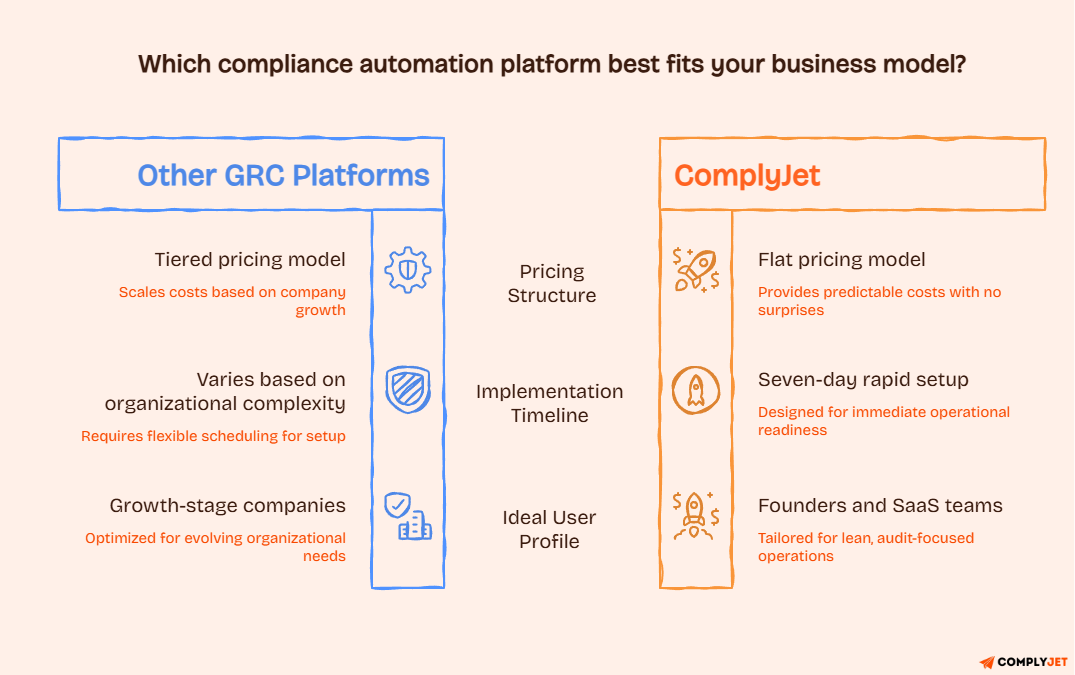
Vanta and Drata are well-known and integrate broadly, but their year-two renewal pricing often increases significantly from the initial contract.
Secureframe is a solid option for teams that want deep audit firm integration.
ComplyJet is built specifically for SaaS companies that want fast onboarding, transparent pricing, and direct control over their compliance program. Pricing starts under $4,999 per year with public plan details, no sales process required.
The platform integrates with your existing cloud tools, automates evidence collection across SOC 2 security criteria, and connects directly with auditors through the ComplyJet Audit Partners network.
If demonstrating SOC 2 security controls to auditors matters to you, your compliance platform is how that happens.
Want to see how ComplyJet fits your audit timeline? Book a demo, and we will walk through your specific setup.
Explore the best SOC 2 compliance software options and compare features before committing.
The right stack does not replace the right auditor. But it makes the engagement cleaner, faster, and more defensible.
The right platform makes the audit easier, but the final buying questions usually come down to the practical doubts teams ask before they commit.
Frequently Asked Questions
What exactly constitutes a certified SOC 2 auditor?
SOC 2 does not have a “certified auditor” designation in the traditional sense. A qualified SOC 2 auditor is a licensed CPA firm enrolled in the peer review program of AICPA, with a state-licensed CPA signing the final report. There is no SOC 2 auditor certification body. Any firm using that language is misrepresenting the framework.
What is the role of service auditors in a SOC 2 engagement?
The service auditor is the CPA firm conducting the attestation engagement. They are responsible for scoping the examination, testing your controls, documenting their procedures, and issuing the final opinion on whether your controls meet the Trust Services Criteria. They are legally accountable to professional standards under SSAE 18 and to the AICPA.
What should a SOC 2 auditor handoff package include?
When transitioning between auditors or finishing an engagement, the outgoing auditor should provide the final Type 1 or Type 2 report, the bridge letter if applicable, the controls matrix tested, the evidence inventory, and documentation of any findings or exceptions noted during fieldwork. Having this package ready reduces the re-scoping effort when you renew annually.
What does a qualified opinion in a SOC 2 report mean?
A qualified opinion means the auditor identified one or more material exceptions in your controls. Specifically, they found evidence that a control did not operate as designed during the observation period. This is different from an unqualified (clean) opinion. Buyers will read the opinion section carefully. A qualified opinion can raise questions in procurement and should be accompanied by your management response explaining the exception and your remediation plan.
How does auditor expertise differ for SOC 2 Type I versus Type II?
Type 1 examines control design at a point in time. It requires less fieldwork, a shorter engagement timeline, and a smaller evidence set. Type 2 examines both design and operating effectiveness over the observation period, which is typically three to twelve months. Type 2 requires sampling across the full observation window, more complex testing procedures, and a higher volume of evidence. For Type 2, auditor depth and methodology matter significantly more. Our SOC 2 Type 2 guide covers the full process in detail.
Should you choose a SOC 2 auditor or a compliance partner?
These are two different things. A SOC 2 auditor is the CPA firm that issues your report. A compliance partner, like a GRC platform or a fractional CISO service, helps you build your controls and prepare your evidence before the audit. AICPA independence rules prohibit the same firm from doing both. You need both for a successful audit, but they must be different entities.
Does it matter if your SOC 2 auditor is more familiar with AWS than GCP?
Yes, it matters. An auditor familiar with AWS understands how CloudTrail logs work, how IAM policies are structured, and what security artifacts look like on that platform. If your environment is GCP and your auditor primarily works with AWS clients, expect more time spent on education during your engagement, which you are paying for. Ask specifically about experience with your cloud provider.
Do you need senior-level SOC 2 auditors on your engagement?
You need senior-level involvement in scoping, testing design, and report review. Whether the person doing individual evidence review is a senior auditor or a well-supervised staff member matters less than whether senior judgment is applied at the critical decision points. Ask about the composition of your specific engagement team, not just the firm’s general staffing model.
What does AICPA-approved mean for SOC 2 auditors, and how do you confirm it?
AICPA-approved means the firm is enrolled in their peer review program and meets the professional standards required to conduct attestation engagements under SSAE 18. You confirm it through the AICPA public database. Search by firm name and verify the current rating and review date.
How does the SOC 2 auditor evaluation process work from the buyer’s side?
Enterprise buyers typically receive your SOC 2 report as part of a vendor security review. Their security team reviews the auditor’s opinion, the testing procedures, and the control descriptions. They may look up the signing firm’s peer review status. If your report includes generic testing language or vague control descriptions, they may request additional information or escalate for closer review. A rigorous report from a credentialed firm reduces the friction in that process and accelerates procurement timelines.
Making the Right Call
The decision you make here will follow you through every enterprise deal you close over the next several years.
A strong SOC 2 report from a rigorous, well-credentialed firm is an asset that shortens sales cycles, builds trust in procurement reviews, and signals that your security program is real.
Start with the legal baseline: verify AICPA accreditation and peer review status before anything else. Then evaluate technical fit, team composition, and scoping methodology. Match your firm tier to your stage and budget. And treat the ongoing relationship as a multi-year partnership, not a one-time transaction.
Before audit conversations begin, make sure your controls documentation and evidence collection process are in order. That work belongs to you, not your auditor.
Your SOC 2 controls list and your gap analysis are the foundation your auditor will build on. Get those right first. Then pick the firm that can do your controls justice.
ComplyJet is built to make that side of the process fast, organised, and audit-ready from day one. Start for free or book a demo to see how it fits your timeline.